


On July 12, about a hundred people walked silently and slowly under the bright sun to Brooklyn’s Metropolitan Detention Center (MDC), the city’s third stop. A day to remember our interdependence pilgrimage. Organized by a collective called Mahasangha NYC, the event invited people of various Buddhist backgrounds and other faiths to join a walk through the five boroughs of New York, featuring rituals, chants, speeches and community building.
The group stopped across the street from the MDC, where past visitors had taped handmade signs reading “Happy Birthday Dad” and “We love you” to a chain-link fence. MDC, New York’s only federal prison, currently holds about 1,200 people, including notorious cases such as former Venezuelan President Nicolás Maduro. THE New York Times reported about the center’s “terrible conditions, near-permanent closures and severe labor shortages.” The MDC is currently detaining hundreds of people in raids and immigration sweeps conducted by Immigration and Customs Enforcement (ICE) over the past eighteen months.
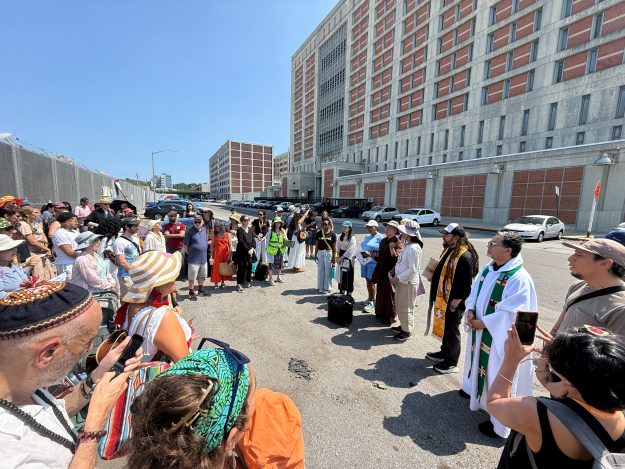
As Sister True Vow of the Blue Cliff Convent led the pilgrim group in a song, people inside the prison began banging on the narrow, fogged windows as if to signal their presence to those outside. “May everyone live in peace, be protected and safe,” the group sang. Dharma teacher Kaira Jewel Lingo expressed this wish in her remarks: “Every person in this building behind us is a person worthy of our love and respect.” Lingo noted that he is about the same age as Lorenzo Salgado Araujo, the man shot and killed by ICE agents in Houston days before, although agents were looking for a different person.
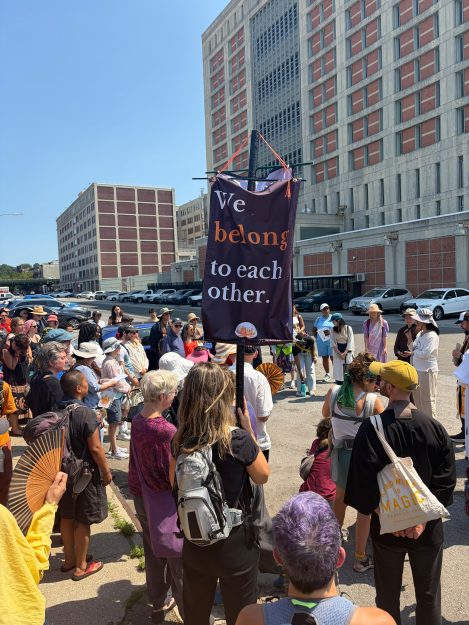
The banging continued as Father Adam Bucko offered a prayer in the Christian tradition, followed by remarks from the Rev. Juan Carlos Ruiz, who leads weekly vigils outside the center and works with some of the inmates. People who were released told him about the terrible conditions inside, which made Newark’s infamous Delaney Hall look like “child’s play.”
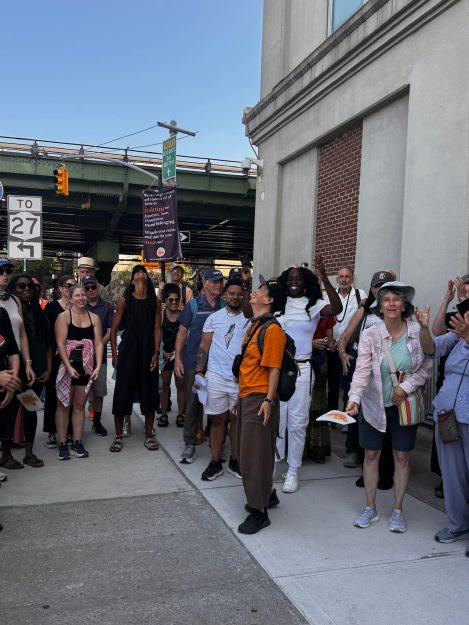
Meanwhile, a team of doctors wearing red crosses circulated through the crowd, offering water, sunscreen, snacks and fans. Pilgrimage co-organizer Mara Phelan, who is a doctor, knew the day would be warm and sunny, so she asked her medically trained friends to sign up. It was one of many small concerns for the group, some of whom had been out since 8am that morning.
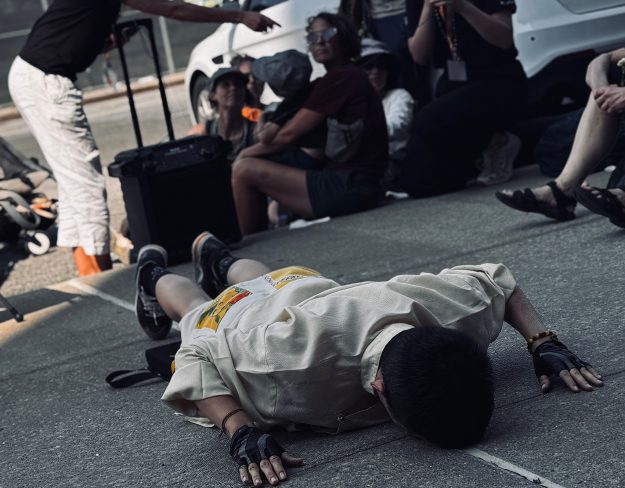
Artist and writer Tenzin Mingyur Paldron then took to the microphone to talk about meeting a Tibetan woman who had been imprisoned for twenty-seven years by Chinese authorities. In prison, the woman learned that the Dalai Lama was still alive and wanted to tell her fellow prisoners to give them hope. But the prisoners were isolated and not allowed to speak, so he sang a well-known song with the line: “After the snow comes the warmth of the sun.” The others pondered, understood the meaning, and rejoiced—all to the confusion of their guards. “They tried to withhold life,” Paldron said. “And we are intangible.Paldron finished with a series of full-body prostrations in front of the MDC as the group chanted.
COrganizer Dorotea Mendoza said that the idea for the day came from a gathering of friends in February. Many were troubled by the state of the country, yet inspired by the Walk for Peacein which a group of monks traveled 2,300 miles barefoot for 110 days from Fort Worth, Texas to the Lincoln Memorial in Washington, DC. “It’s like a call and response,” Mendoza said. “That was their call, what is our answer?”
During many conversations and iterations, the organizing group of about ten people, mostly women of color, came up with the idea of organizing a similar walk. Like Békjárás, they would not formulate a political message, but stick to their deepest values. “I wasn’t trying to fix something,” Mendoza said of his time away from MDC. “That in itself feels easy.”
Some pilgrimage organizers, such as Stephanie Cates, met through environmental justice and activist spaces around Palestine, but Cates felt it was important to “bring others in as our own, even those who I might see as my enemy, like an ICE agent.” According to Milou Haskin, another organizer, the pilgrimage is not about making demands. “Actually, we’re not waiting for anyone,” he said. “We want to stick to how much we love each other and (care for) each other — so that this little microcosm embodies everything we want from the world.”
A Day of Remembrance for Our Collaboration inspired similar walks that weekend in Austin, Texas; New Orleans, Louisiana; and Troy, New York. The emphasis on interdenominational Buddhism echoes the Let’s get together memorials in Los Angeles and Antioch, California that use rituals to call attention to historical and current anti-Asian violence. And many participants are connected through other cross-line networks, such as the Buddhist Council of New York and the Buddhist Action Coalition.
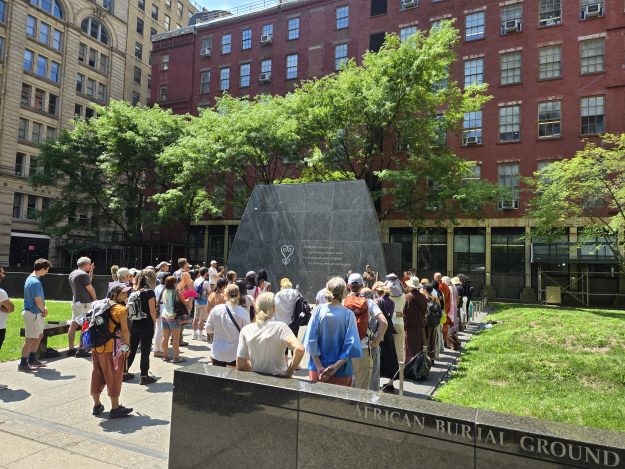
For the New York pilgrimage, the day began at two separate points: the Staten Island 9/11 Memorial and the Banana Kelly double dutch sculpture in the Bronx, an iconic work by John Ahearn and Rigoberto Torres from 1982. The two groups later met on foot and by public transportation at the African Burial Ground National Monument, where two members of the Ramapo Munsee Lenape Nation, Grandma Clara Soaring Hawk and Owl Steven Dennison Smith, gave a blessing. The group then stopped for lunch in Brooklyn before heading to MDC. During the day, the participants were asked two questions: What stories does this place hold that I haven’t learned to hear yet? What would it mean to encounter this place with an open heart rather than certainty?
The event’s website described it as a “Buddhist-led interfaith” walk where “everyone is welcome.” Michael Shen, one of the volunteer doctors, does not identify as a practicing Buddhist, but said, “It was great to walk quietly and reflect on our relationships.” He added that it was “heartbreaking” to hear the knocking on the MDC’s windows, which “reinforced the fact that there were people inside” and that he was considering returning to the weekly vigil.
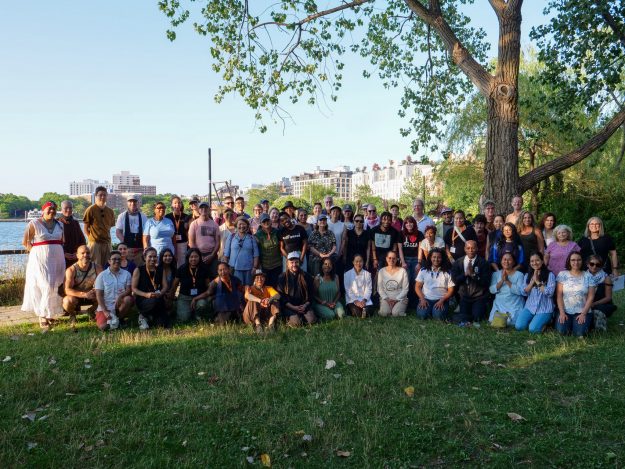
TThe last stop of the day was Socrates Sculpture Park in Queens, where organizers arrived early to set up the chairs, along with chips, wraps and pastries. Walkers gathered under the trees overlooking the East River as the sun set. There was more singing and speakers emphasized our interdependence with nature and respect for the natives of the land. Reverend James A. Lynch of the Buddhist Council of New York, among many others, “offered the merit of the day to those who feel forgotten, abandoned, invisible or lonely.” Reverend Doyeon Park of the Won Buddhist community spoke about using the four great vows, including “Sentient beings are countless; we vow to save them,” as a guide for our action, and then chanted them in Korean.
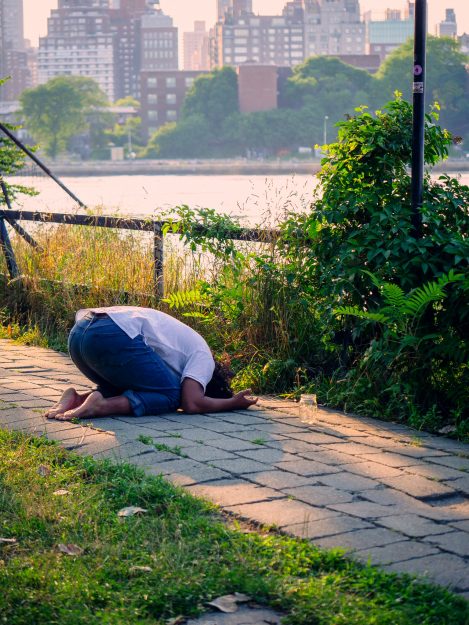
To conclude the pilgrimage, Mendoza raised a jar containing water from Staten Island and the Bronx and asked fellow organizer and environmental activist Matthew Menzies to lead a ceremony. Menzies spoke of his own experience of being born on the East River and his Aboriginal roots to name the complexity of our origins. “Your home flows within you,” he said, then poured the jar into the river so that the waters of the five neighborhoods could mix.
Phelan stood by the river with tears in his eyes at the end of the day. “I used to organize spaces and something was always missing, so I came to the conclusion that organizing was not for me,” he said. Phelan added that the protest was absolutely necessary, but the day to remember our interdependence showed him what he was missing. “I really needed the faith part, I really needed the Buddhist spiritual part, I really needed love. It feels like coming home to find the place where I belong and the people I want to organize with.”
The post Moving Church appeared for the first time Tricycle: The Buddhist Review.



