


“When I was a boy in Uganda,” Bhante Buddharakkhita told us at the start of our Walking in the Footsteps of the Buddha pilgrimage in March 2026, “I was so frustrated when I just couldn’t get a delicious-looking mango to fall off the tree, no matter how many times I hit it with a stick.”
“My brother always seemed to get it,” he added with a characteristic laugh, “but me? Never!”
Then his brother told him the problem: he wasn’t aiming high enough. He had to hit the branch above the fruit. Bhante learned and reaped the fruits of his labor—literally and metaphorically. He began to reach higher, and he carries this lesson in his life and teaching even today.
During the time we spent together, Bhante Buddharakkhita often talked about the Buddhist monastery he founded in Uganda, which now not only trains monks, but also educates children in high school, as well as helping the local community by providing health resources, clean water, and building more boreholes or wells, all while teaching meditation. Pragmatism goes hand in hand with the strong Buddhist faith that underpins the Uganda Buddhist Center (UBC). In a country where converts are the rule, Bhante is not looking for followers. It simply offers the teachings of the Buddha, even as it welcomes and respects local traditions. (Buddhism taught in Uganda always has an “African flavor.” What is that flavor? he was asked. “Chocolate,” he replied.) And the number of visitors to the Buddhist center continues to grow.
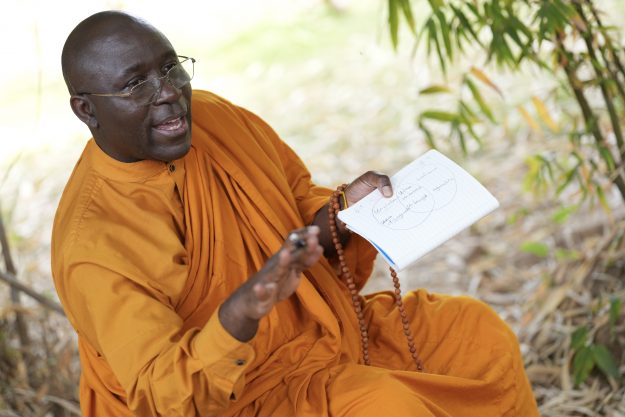
“When I started the monastery,” says Bhante, “it was a tented monastery. And I was the only member.” Bhante laughs at the memory. He never doubted his purpose and never thought that he would not succeed. He continues: “Then a second member joined: my mother!” Bhante’s mother, who has since become a Buddhist nun and still lives at UBC, actually started him on the path to meditation and monasticism. From a young age, he said, “If you have nothing to say, keep quiet.” And so he did.
Almost a year ago, I saw the announcement of the Walking in the Footsteps of the Buddha pilgrimage on Tricycle.org. HEf Naturally, I was tempted by the opportunity to travel with like-minded pilgrims, who turned out to be extremely generous practitioners. But Bhante’s smiling face looking at me from the screen sealed the deal.
Still, I didn’t know what to expect. I never spent much time with a monk, and through our travels together I learned the rhythm of a monk’s life, while also learning from his dharma talks. Our pilgrim days began very early as Bhante did not eat after noon. Although I spent time in Thailand watching ordinary people on the street and in temples offering food to monks, I did not translate this into how a monk like Bhante might practice in a pilgrimage setting.
The first time I was able to serve Bhante food was an exciting honor. Even though I only served him a regular breakfast—porridge, yogurt, bread, and fruit—I felt like I was part of a thousand-year-old tradition.
Our first official stop at Sarnath, the Deer Park, where the Buddha gave his first sermon to just five followers, was a revelation to me. Of course I had heard the teaching about the four noble truths and the eightfold path and impermanence and interconnectedness, but here, walking clockwise around the Sarnath Stupa with Bhante, this learning resonated in a way I had not experienced before. I began to understand what it means to be a part of this tradition of pilgrims, followers and students. I was transported not only by Bhante’s words and the singing processions of pilgrims suddenly called Sangha, but also by the singing processions of pilgrims wearing clothing that revealed they had come from Vietnam, Thailand, Sri Lanka and elsewhere.
In Uganda, Bhante, in one of his speeches, reflected on a proverb that says, “If you eat a worm in the mushroom, the worm will eat you.” But Buddhism goes beyond this determinism, this inevitability, and as Bhante reminded us, the Buddha offered another view: You can always start over. You can admit over and over and over that you were clumsy because you will be clumsy, over and over and over.
The impact of this teaching, which I had of course heard before, was reinforced when I heard Bhante’s words immediately after seeing the skeletal, dying Buddha statue in the Mahakala Cave near Bodhgaya. This statue sends an inescapable message: Buddha turned so dramatically and bluntly from his privileged past that it nearly killed him. He was only able to start again when he accepted Sudjat milk rice and only when he stepped on the Middle Way after six years of austerity.
“I am a monk who does not end the spiritual practice,” said Bhante Buddharakkita on one of the last days we spent together, “so this is the beginning of a pilgrimage: a lifelong pilgrimage of states of mind.
He spoke without notes, as he had during many of our days together, beginning with the first lines the Dhammapada: “Mind precedes all mental states. The mind is their boss; they are all brain-worked. If one speaks or acts with an impure mind, suffering follows him like the wheel that follows the feet of the ox.”
But he didn’t stop at reciting the lines—he looked at each of us and asked, “Will the wheels of the cart ever catch up with the oxen?” Of course not, and he added, “When the ox pulls the cart, it suffers; and so we suffer when we pull the heaviness of our minds.”
When I got home, I looked up the Dhammapada and discovered that the second line is:Mind precedes all mental states. The mind is their boss; they are all brain-worked. If one speaks or acts with a pure soul, happiness follows him like his never-fading shadow. The teachings that Bhante emphasized during the weeks we spent together included the concepts fasting and fastinghealthiness and unhealthiness, again resonated.
Our pilgrimage was not like the quiet retreats I have attended in the past. We meditated together every morning, and more briefly at other times of the day, but our days were busy, full of noise and distraction. Yet, each step we took while following the Buddha offered an opportunity for the Buddha’s values to permeate our lives.
From my privileged seat on an air-conditioned bus, I looked out the window at people working hard and living their lives, buying and selling fruit and vegetables, walking to school and work, or cultivating their land. Seeing the dignity of their efforts, I became more fully aware of my kinship with all mankind; watching for miles became a kind of meditation for me.
All the while I thought, “May all beings be happy, may all beings be peaceful, may all beings be free.”
I am grateful to have started this pilgrimage with Bhante.
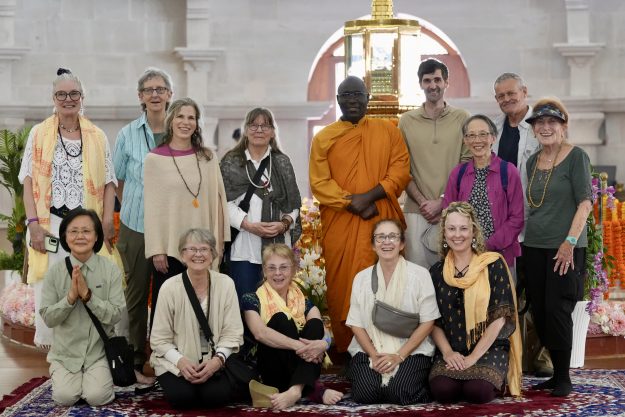
Videos of Bhante Buddharakkhita’s 2026 Walking in the Steps of the Buddha pilgrimage teaching are available for viewing here.
Brief Teaching of Bhante Buddharakkhita: The Most Dangerous Weapon
“I remember when I was a student in India, I had a friend who said that there are three things you can never change. And he started saying: one is a speeding arrow. Once the arrow is released, you cannot catch it. The other is a missed opportunity. Once you have an opportunity and you miss it, you neglect it, you never get it back. The other is a spoken word.
After you’ve said it, all you can say is, “Okay, sorry, sorry!” But you said you can’t say it. Same thing with email, you know. I think AOL (usually) gives you time at the beginning of the email to decide if you want to send it (or not). But once you click the “Submit” button, you’re done. Maybe you can write “I sent it by mistake”, but it’s a shame it disappeared. Sent messages cannot be deleted. So it’s the same with speech, you can’t delete spoken words.
Do you know the most dangerous weapon? This is the softest, but also the most dangerous.
do you know You will say bombs. What is the most dangerous weapon? It’s so soft, it doesn’t even have a bone in it. (From the audience: “We’re talking!”) Yes, it is. This is the most dangerous, because once you say something harsh, the person you spoke to will never forget it. It can ruin your relationship.
I tell you, (all you have to do) is to say (just) one thing, even if you have done so many, many good things, just (saying) one word can cause the whole thing to fall apart. There’s a saying, “You’ll never regret keeping quiet.”
Of course, the Buddha never approved of people being dumb and not talking at all. He said that when you meet, talk about the dharma or observe noble silence. In this case, he is not talking about complete silence. Noble silence is when you practice meditation and enter the second jhana, then there is noble silence. There’s always internal chatter going on in front of it, even when you’re silent, like apps running in the background on your phone.”
Adapted from Bhante Buddharakkhita’s lecture at the Rajgiri Bamboo Grove in March 2026.



