
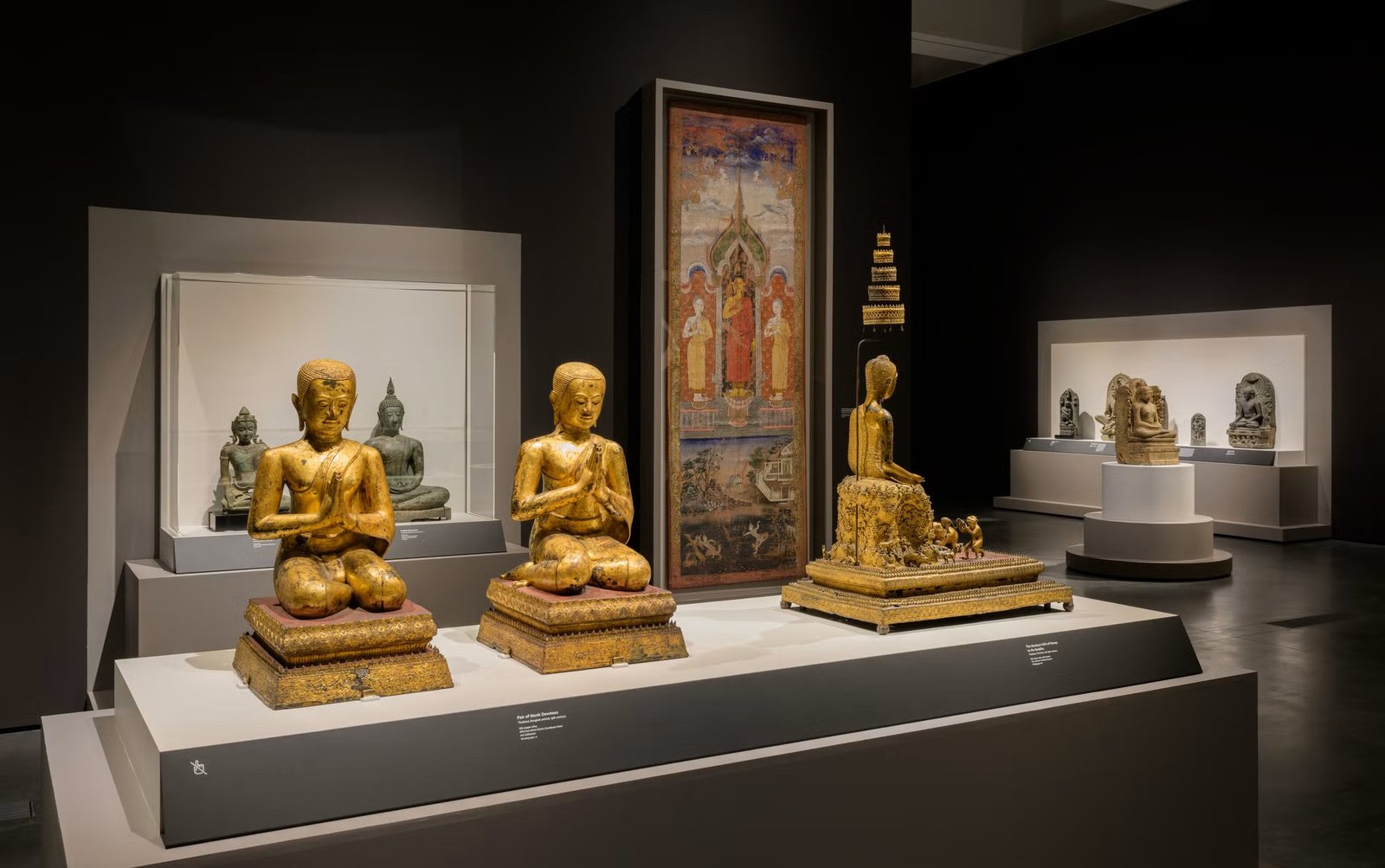

When Pratapaditya Pal arrived in Los Angeles in 1970 to head the new Department of Indian and Islamic Art at the Los Angeles County Museum of Art, he began to expand the museum’s collection both culturally and spiritually. Over the next twenty-five years, Pal drew on his vast scholarly knowledge, boundless energy, and contacts with collectors to significantly expand his Himalayan and Islamic collections, transforming LACMA’s modest holdings of Indian and Southeast Asian art into one of the country’s preeminent collections. For visitors who associate LACMA with modern and contemporary art, the depth and range of Buddhist art can be particularly surprising.
As the museum prepares to open its new main building, “Realms of the Dharma: Buddhist Art Across Asia” (on view: until July 12, 2026) brings together LACMA’s Buddhist art collection in one space for the first time.It is curated by Stephen Little, Head of Chinese and Korean Art, and Tushara Bindu Gudeformer curator of South and Southeast Asian art at LACMA, the exhibit features approximately 180 paintings, sculptures, ritual objects, and sacred texts—mostly from the museum’s permanent collection.

Upon entering the exhibition, visitors are met on their left by a tall, imposing figure wearing a gray mantle, a toga robe, and a thoughtful expression on his face. He represents Avalokiteshvara, a bodhisattva – a compassionate being who postpones his own final Buddhahood and final nirvana to save all sentient beings from suffering. Bodhisattvas figure prominently in Mahayana Buddhism, which began to spread across much of Asia almost 2,000 years ago, around the same time that Buddhist teachings were first written down in sutras. This is when the earliest images of the Buddha and other deities appeared in northern India and Gandhara (present-day Afghanistan and Pakistan), where such figures were carved around 200 BC. Executed in the Greco-Roman style characteristic of the region, the bodhisattva wears princely robes and jewelry, symbolizing his continued presence in the material realm, in contrast to more familiar images of the Buddha, whose simple monastic robes signify liberation. Purchased in 1983, the statue remains one of the most significant Buddhist works in LACMA’s collection.
Until recently, the largest collections of Buddhist art in the United States were held by East Coast institutions—the Metropolitan Museum of Art in New York, the Art Institute of Chicago, and the Museum of Fine Arts in Boston (all founded in the 1870s) and the National Museum of Asian Art in Washington (founded in the 1920s). The West Coast, and California in particular, has much younger institutions, many of which were established in the mid-20th century as the region grew in population and wealth. San Francisco’s Asian Art Museum built an impressive collection of Buddhist art in the 1960s, thanks to the generosity of its founder Avery Brundage, but LACMA, founded in 1961, was a relative latecomer despite Southern California’s large and diverse Asian immigrant communities.
In 1969, LACMA Director Kenneth Donahue contemplated the museum’s first major acquisition of Indian art—235 works from the collection of Nasli and Alice Heeramaneck, a collection of collectors and dealers active in many regions of the world. He consulted with Pal, an Indian scholar specializing in South Asian art at the Museum of Fine Arts, Boston, and persuaded him to move to Los Angeles the following year to head the museum’s new Indian and Islamic art department; Pal later became Senior Curator of Indian and Southeast Asian Art. Armed with two PhDs, a tireless work ethic, and major collectors including Anna Bing Arnold and Joan Pavlensky, as well as institutional support from the Ahmanson Foundation, Pal oversaw a dramatic expansion of the collection. In the 1970s, he also helped collector Norton Simon build his extensive collection of South Asian art, now housed at the Norton Simon Museum in Pasadena. By the time Pal left LACMA in 1995, the museum’s collection of Indian, Islamic, and Southeast Asian art had grown to 4,000 works.

Among the works acquired in 1969 was an early Kashmiri seated Buddha dating from around 725-750 AD. Cast in brass and decorated with silver, this figure illustrates the fine metalwork of the Himalayan region, famous for its excellent Buddhist and Hindu deities in copper, bronze and brass, often decorated with silver or gold. The buddha exudes a calmness and strength befitting a being who has transcended this realm and attained nirvana, and wears a kind, serene expression. The statue depicts either the historical Buddha Shakyamuni or the cosmic Buddha Vairochana; Both are seen holding hands in the gesture of “turning the wheel of the law” (Skt.: dharmachakra mudra) and sitting in full lotus position (meditation posture). He sits on an openwork lion throne, a symbol of kingship that underscores his spiritual sovereignty, with a demigod (yaksha) as its center, next to it are two rearing griffins.

A seated Buddha from more than a thousand years later, from Laos or northern Thailand, offers an instructive regional comparison. The figure, cast from a copper alloy and detailed with rock crystal and obsidian, can be identified as the historical Buddha Shakyamuni with his right hand touching the ground (bhumiparsha mudra), which commemorates the moment of his enlightenment, when he called Earth to witness his victory over the demon Mara. Localized features can be seen in the image – a wider nose, simpler handling of the robe and the throne – but the most typical regional version is the ornate, elongated skull extension, or come acrossa physical sign indicating the Buddha’s transcendent wisdom. This “flaming usnisha” is characteristic of Thai and Lao Buddha figures from the 14th century onwards and is relatively rare in Western museum collections. This figure was donated to LACMA by Michael Phillips, a renowned collector of Himalayan, Indian and Southeast Asian Buddhist art and, perhaps less expectedly, the Oscar-winning producer behind it. The Sting and Taxi driver.

One of the most spectacular works of art in the exhibition is a 15th-century Tibetan painting depicting the Buddhist deities Chakrasamvara and Vajravarahi in a sexual embrace. Chakrasamvara (meaning “Wheel of Happiness”) symbolizes the blissful state of perfect wisdom and is one of the most important deities of Vajrayana, an esoteric form of Mahayana Buddhism that developed between the 5th and 7th centuries and became the dominant tradition of Tibet. Mantras, visualizations, and mandalas are central practices in this tradition, and paintings and sculptures of deities in a sexual embrace serve as visualization tools for practitioners. The hug, by its Tibetan name yum-yumor “father-mother” represents the union of wisdom (the feminine principle) and compassion (the masculine) considered necessary for enlightenment. Despite its age, the colors of the painting remain remarkably vivid, a testament to the skill of its creator, a Newar artist from Nepal who worked in Tibet.

LACMA’s collection of Buddhist art also includes paintings, sculptures, and calligraphy from East Asia, with some particularly outstanding Japanese examples. Among them is an elegant wooden statue of the bodhisattva Kshitigarbha (Jp.: Jizo), dating from the Heian period (794–1185) and standing over six feet tall—remarkable for its exquisite features, dimensions, and excellent condition. With a shaven head like a monk, carrying a monk’s staff and sacred jewelry, Jizo is one of the most beloved deities in Japan, revered for protecting children in this realm and the afterlife, including Hell. Carved from a single block of wood and originally coated with pigments, the figure exudes the compassion of a bodhisattva while projecting the gentle, humble presence of a buddha.
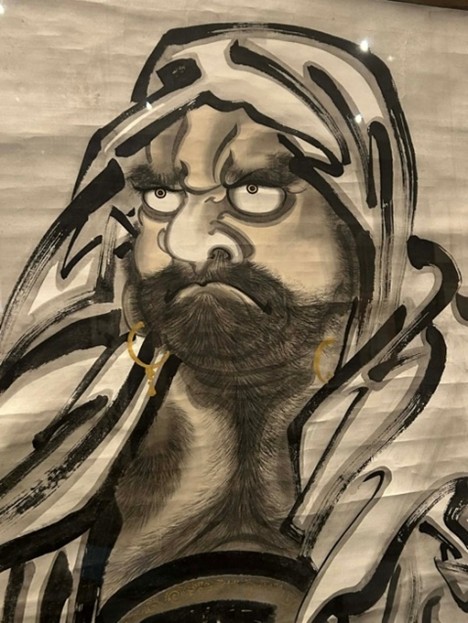
In contrast to the serene calmness of Jizo, the monumental ink painting of the monk Bodhidharma projects a far more formidable presence. Bodhidharma is credited with the transmission of meditation – by its Sanskrit name dhyanabut better known by its Japanese name, Zen – from India to China. According to legend, he was so determined to achieve enlightenment through meditation that he cut off his eyelids to avoid falling asleep, which is why pictures of him usually show large, bug-eyed eyes beneath his furrowed brows. Unlike other Buddhist traditions, Zen does not employ statues or paintings of deities; instead, landscape paintings, calligraphic inscriptions, and portraits of Zen teachers served as focal points for meditation. In this large and dramatic portrait, Japanese artist Kawanabe Kyōsai (1831–89), known for his paintings of demons and monsters and his vivid woodblock prints, captures the intense concentration of the legendary master with quick, bold brushwork and careful shading. Donated in 2024 by Etsuko and Joe Price, who also supported the construction of LACMA’s Japan Pavilion, it is among the latest additions to the museum’s Buddhist art holdings.
Until now, many of the works discussed here have been displayed separately in regional gallery settings. “Realms of the Dharma” brings them together for the first time, bringing together LACMA’s holdings from across Asia—India, Sri Lanka, Afghanistan, Nepal, Kashmir, Tibet, China, Korea, Japan, Thailand, Myanmar, Indonesia, Vietnam, Cambodia, and Laos—in a single, wide-ranging survey of how the museum came to be revisited. That this is even possible is part of Pratapaditya Pal’s legacy of bringing exceptional examples of Asian spiritual art to Los Angeles—home to one of the most diverse communities in the world today, with practitioners of Buddhism and other Asian spiritual traditions drawn from Asia and the West. It seems fitting that the city’s great public art museum has quietly become one of the country’s most important repositories of art inspired by these traditions, and an exhibition like “Dharma’s Realm” makes it visible.



