
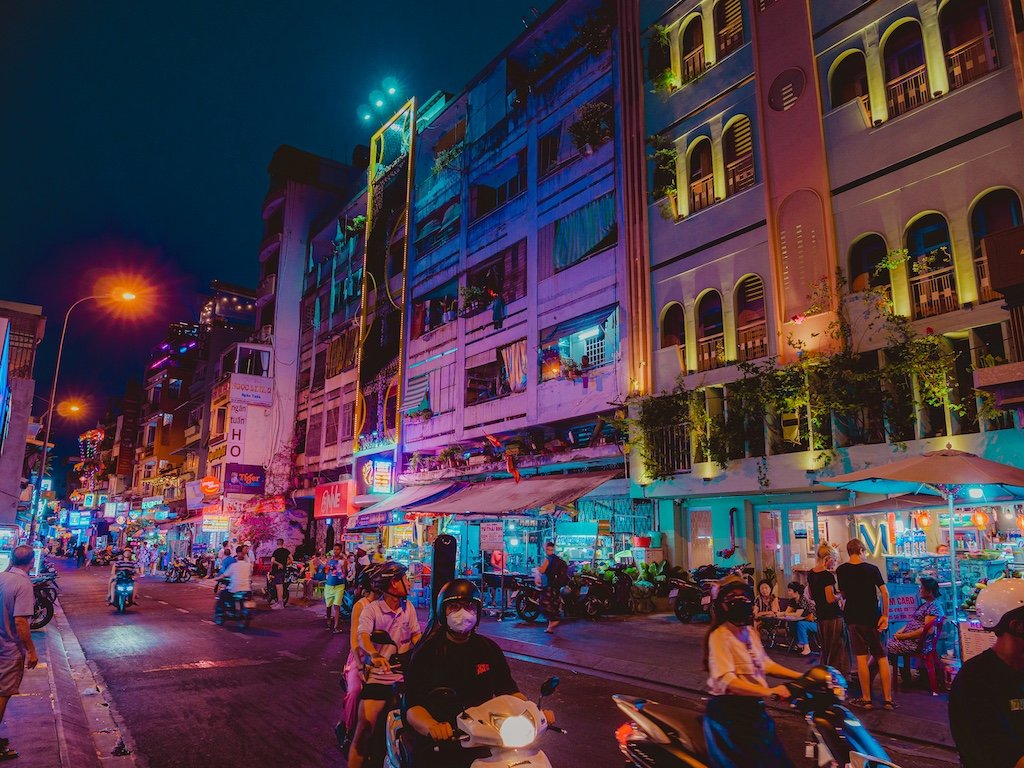

Truc’s motorcycle died at a traffic light in downtown Ho Chi Minh City. Nightlife was happening all around us in a parade of crowded cafes, food carts, karaoke bars, neon lights, vendors, beggars, kids, motorbikes, horns, laughter, toasts and fights all blaring together to the rhythm of distant club music.
The traffic light turned green. Engines streamed around us. Truc’s moped remained as still as a rock in a stream.
He put his foot down to stabilize the vehicle. I followed, careful to keep my toes out of traffic. Plastic bags – containing two dozen meals in Styrofoam boxes – swung precariously from the cog under the moped’s handlebars. The 24-year-old laughed as she stabilized the bags. Sitting behind him, I balanced the bag of milk sandwiched between us.
For the past hour, we have been giving hot meals to people living on the streets of the city’s central Phu Nhuan district. Truc drove while I scanned the sidewalks for people getting ready to sleep outside. Every few minutes we saw people laying out cardboard and bedding to rest on park benches or ATM kiosks. He instructed me to look out for the elderly, disabled or single mothers with children. Every time I identified someone who met Truc’s criteria and approval, he would pull over to the curb, idle his moped, and hand me a Styrofoam box.
I dismounted, placed a milk pouch on top of the box, and walked up to the recipient and asked, as he instructed, “Have you eaten yet?” The question is a commonly used greeting among family and friends. The purpose of the questioning was to create a brief, “loving” relationship with the recipients by expressing concern for their well-being.
Most of the recipients accepted our food with thanks, smiles and gestures towards Truc. Some insisted that someone needed the food, or at least the milk packet, more. As we drove, Truc waxed poetic about the goodness of such people: they had nothing, yet gave everything they could. For him, this altruism meant the “ethical” life – literally translated: “on the path of virtue” (Vn.: knife).
That evening we volunteered together with six acquaintances whom Truc knew. Everyone went to different neighborhoods to distribute the food in teams of two by motorbike. While the others usually finished the delivery by 9pm, Truc always insisted that we start later. If we started after 9 or 10 p.m., he reasoned, whoever pretends to beg would have already left the street to sleep at home.
Our mission was to find recipients whom Truc believed to be completely dependent on the kindness of others. He did not want our charity to allow fraud or lying, which would undermine the spiritual “blessings” of altruism both for ourselves and for the recipients.
Like most volunteers I met, Truc used the word “blessing” interchangeably with the Buddhist term “merit.” He valued charity through the Buddhist understanding of the universe, often referred to as “cosmology”. Altruism, he explained, fundamentally improved the quality of life of charity recipients and “evolved the heart” for everyone involved—hearts evolved because caring influenced karma.
The word karma means “action” in Sanskrit. In most Buddhist cosmologies, all actions of “body, speech, and mind” have material consequences through karma. These consequences show the living conditions, appearance, feelings, environment and relationships of “sentient beings”. Karma drives the reincarnation cycle known as samsara. Samsara means “wandering,” indicating that sentient beings wander through the realms of incarnation. Our thoughts, words, and actions in the “present incarnation” have karmic consequences that apply both in this life and in “future incarnations.” A “right” or “good” action improves karma and usually leads to pleasant effects such as greater health, wealth, happiness, beauty, and success. In contrast, a “bad” or “evil” action has unpleasant consequences such as disease, poverty, pain, ugliness, and misfortune.
Elite monks may focus on achieving nirvana to escape samsara altogether. However, non-monastic laymen and lower-ranking monks (often women) tended to focus on gaining merit and improving karma in this and future incarnations. They may feel—or have been told—that nirvana is unattainable in this life, given the “heaviness” of their accumulated karma. Most Buddhist followers, rather than striving for instant nirvana, work to “lighten” their heavy karma. Common practices for improving karma include chanting sutras, reciting the Buddha’s name, attending bimonthly penance rituals, and donating to temples. Buddhists increasingly see charity in society as another form of charity Danabeyond ritual donations to temples.
Philanthropy was much more than meets the eye: giving could spark a cosmic revolution by improving the karma of all sentient beings for lifetimes.
For volunteers like Truc, philanthropy created a positive feedback loop that improved the karma of not only the donor but also the recipient. The donor could earn merit through selfless giving, and the recipient through humble gratitude and happiness for the gift. Some volunteers claimed that the gifted could even gain merit by being around a spiritually advanced being. Charity was more than meets the eye: giving could spark a cosmic revolution by improving the karma of all sentient beings for lifetimes. Buddhist charity can literally change the world.
When Truc’s moped stopped during our food distribution, I thought we were done for the night. To no avail, he turned the ignition key, then held up his hand and shouted that we should only “walk” to finish the food distribution. I laughed at his jokes.
A young man stood next to us and offered to drive us home. Truc agreed. He propped his shoe against the footrest of his vehicle and drove us down the road.
As soon as we arrived at the garage shed where Truc lived and ran his milk tea business, he rolled the moped. We unpacked the food. I took out my smartphone to call a motorbike taxi back to my apartment. When I looked up, Trúc was standing at the door with the bags of food in his hands.
“Let’s go!” she announced.
He wasn’t kidding. I put my phone away and accepted the heavy bag of milk. We wanted to finish the charity event on foot.
We walked more than 10 km (about six miles) around Truc looking for the right recipients. I slowed down as my feet ached in a pair of sturdy hiking boots, but Truc ran ahead, smoothing over traffic barriers in his thin gold sandals.
Around midnight I pretended to collapse and suggested we keep the food in my fridge to distribute after his bike was fixed. Truc ignored my performance and replied that this job is not just about eating. Each dinner cost only 10,000-20,000 Vietnam Dong (VND) to prepare – less than one US dollar (USD) at the time. The ingredients were cheap, even for someone who couldn’t afford shelter. Anyone could beg for enough money to buy a dinner like ours every night. It would certainly be easier and more convenient to give out the same amount of cash instead of food. (Truc lifted the bags to emphasize their weight.) But the purpose of charity was not just to feed people. Our real intention was to ‘comfort’ people by sharing home cooked food with love. These dishes showed that someone cares enough about their guests to cook their dinner by hand with healthy ingredients. Donating food could not “solve all the social problems” that caused unemployment, poverty and homelessness, but it would “warm” the hearts of the beneficiaries for a night.
Around one o’clock in the morning, we left our last container next to an old man sleeping in a rickshaw. The food was no longer hot and the rickshaw driver was not awake to get it. Truc mused that at some point in the night he would wake up and feel “touched” that someone had noticed.
For Truc, altruism worked best when it affected emotions. The purpose of giving was to create a ripple that would spread the donors’ “love” and “happiness” through the recipients, beyond individuals, throughout the city, and into the wider web of existence. If positive feelings were shared, karma was affected, and when karma, society improved.
Our night’s work is done, but the karmic transformation has only just begun.
♦
From Near Light We Shine: Buddhist Charity in Urban Vietnam By Sara Ann Swenson. © Oxford University Press, 2025. Reprinted with permission.



