In April 2026, New York’s High Line unveiled its newest installation: a twenty-seven-foot sandstone Buddha by Vietnamese American artist Tuan Andrew Nguyen. Titled The Light that shines through the Universethe sculpture is inspired by the colossal 6th-century Buddhas of Bamiyan, which were destroyed by the Taliban in 2001; In fact, the brass hands suspended in front of the sandstone body were cast from ballistic shell casings from Afghanistan’s Bamiyan Valley.
As a multidisciplinary artist, Nguyen often recycles materials from war to examine the afterlife of violence and colonialism, turning unexploded ordnance into artwork. Through his innovative sculptures, films and sound installations, the 2025 MacArthur Fellow explores how to activate material memory and give life to forgotten or erased stories. (Tricycle He presented his sculpture made in 2022 Broken armswhich adorns an antique statue of Quan Yin with brass arms cast from salvaged artillery shells in the Summer issue 2026.)
The a latest episode Tricycle conversations, TricycleEditor-in-Chief James Shaheen sat down with Nguyen to discuss the background behind the new installation, his process of transforming remnants of war into sculptural objects, the interplay of Buddhism and animism in his work, and how the teachings of reincarnation inform his artistic practice.
He recently unveiled a new project on New York’s High Line, a twenty-seven-foot tall Buddha modeled after one of the two Buddhas in Bamiyan. So can you tell us about the Buddhas of Bamiyan and why you decided to make a sculpture based on them? The Buddhas of Bamiyan have always taught me a profound lesson about impermanence and the instability of what we think of as permanent. These monumental figures stood on the rocks of Afghanistan’s Bamiyan Valley for more than 1,500 years. They were built in the 6th century in a place and at a moment where many cultures, religions and trade routes crossed each other at the end of the Silk Road. In a sense, they embodied the idea of interdependence and were shaped by many cultures: Greek culture, Persian culture, Central Asian culture, and Buddhist culture all at once. So they were spectacular objects, especially at that time.
In Buddhist philosophy, emptiness is not simply about lack or loss; it is a space of potential.
These Bamiyan Buddhas were destroyed by the Taliban in 2001. The event is often framed as the destruction of cultural heritage, which of course it was. But I was interested in the emptiness left behind by the destruction. In Buddhist philosophy, emptiness is not simply about absence or loss; it is a space of potential. And I think for me these reincarnation ideas are quite interesting. So when I had the opportunity to pitch something for the High Line, I immediately thought I’d go back to that moment in recent history to see what I could do with it.
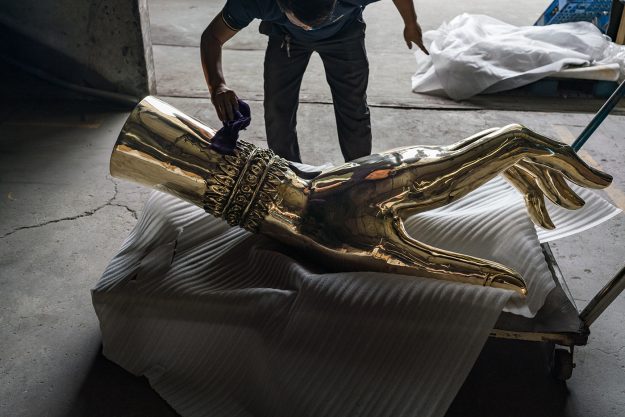
In the sculpture, you use brass hands that you cast from ballistic shell casings found in Afghanistan. So can you tell us about the process of sourcing these shell casings? The statue consists of two parts. The main part, which echoes the original larger Buddha, Salsal, is made of sandstone and hand-carved in Da Nang, the central region of Vietnam where I currently live. It was carved by a dear friend of mine, Mr. Hong, who is a fifth-generation stonemason. So this is the stone part. Then there are hands that are suspended in front of the stone, and these hands are speculative in that the Bamiyan Buddhas have been mutilated and wounded, bearing evidence of destruction over hundreds of years of various political regimes and attacks throughout history. We made these hands out of brass and I have to say they sparkle beautifully in the New York sunlight.
The hands were cast from artillery shells that we acquired in Afghanistan. It was a very difficult process and I could not have done it without a friend named Khadim Ali. He is an artist I first met in 2018, and he told me stories about how he played at the feet of the Bamiyan Buddhas as a small child. He is a Hazara, and for many Hazara people the Bamiyan Buddhas are significant icons. The Hazaras are the primary inhabitants of the Bamiyan region today, and the Buddhas have been part of their landscape for a very long time. And although Buddha statues were created in a Buddhist context many centuries before Islam became the region’s dominant religion, for the Hazaras Buddhas are less about Buddhism and more about icons of their identity, cultural memory and local heritage.
Through his remaining networks in Afghanistan, his second cousins and distant uncles, Khadim was able to help me obtain brass shells from Afghanistan. They had to be poured into bowls to get across the Afghan border into Pakistan, and from Pakistan we poured them again into more decorative bowls to be transported to Vietnam. And it was in Vietnam where we gave them to the Buddha.
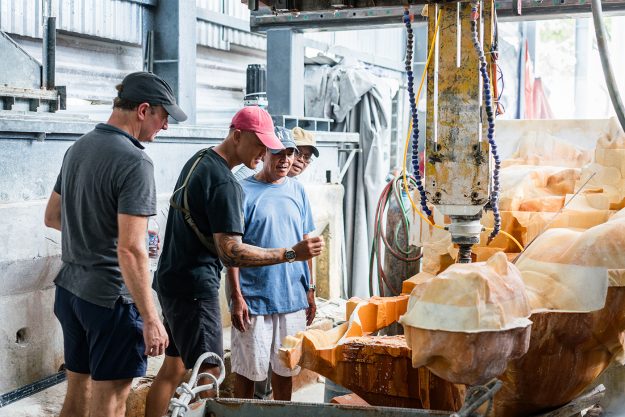
The recycling of weapons and remnants of war has been the main theme of your work, and in Vietnam, together with community members, you collected pieces of unexploded ordnance and transformed them into sculptures. So tell us about how you transform these weapons of war. The transformation of war remains into sculptural objects began as a way of materially thinking about memory. In Vietnam, the war is not only in the past or in the archives. It still exists physically in the soil, in rivers, in bodies, in landscapes that, even half a century later, carry the unexploded ordnance and the poisons of war. The war ended in 1975, but it remains a latent presence. Thus, my work with this material is actually the material form of my relationship with the communities that live with the material.
I think materials absorb energy. They absorb ideology. They absorb violence. The bomb or projectile was designed with a very unique purpose: to destroy, to dismember, to impose power. But I think that if these objects are removed from their military function, they potentially take on a different meaning. In many Vietnamese communities, especially in the region where I work in Quang Tri, war remains have long been recycled into everyday life: people turn them into spoons, pots, shovels, fences, and even children’s toys. There is already a kind of vernacular conversion practice that has evolved out of necessity and flexibility. So my work is really in dialogue with existing knowledge. He investigates how materials can carry memory – and how they can be transformed to tell a different story.
One of the guiding philosophies of these works is animism. So can you talk about how animism influences your work? Animism is a belief system that is still very strong in Southeast Asia, especially Vietnam. Both of my grandmothers believed very strongly in animism. Essentially, animism resists the idea that the world is made up of inert objects intended solely for human use. Everything has a soul or spirit. Materials, objects, landscapes, rivers, animals, even the remnants of war have some possibility of action, some spirit or presence. And that worldview resonates very deeply with me, especially with the stories and the materials I work with.
In the Southeast Asian context, Buddhism and animism are not experienced as separate systems. They coexist fluidly in everyday life. One could even say that animistic thinking influenced the ideas of reincarnation in Buddhism. In Vietnam, there are practices of honoring ancestors and offerings to spirits, ghost houses, beliefs linked to certain trees, stones or bodies of water. All this is based on animistic ideas.
To me, animism allows us to look at materials and objects with a kind of presence, and this idea of reincarnation fits. And when I mean material memory, it’s actually based on the animistic belief that materials can have charge. They have history. And when I’m working on remaking some of the material, I’m not trying to get rid of that history, I’m trying to have a dialogue with the stories that those materials contain.
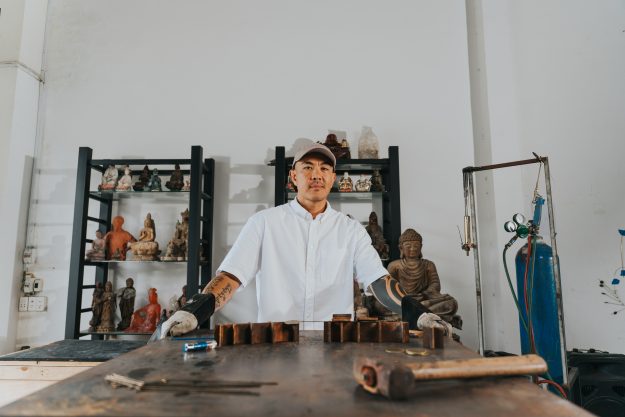
On the theme of reincarnation, he also recycles materials from his films in his sculptures and vice versa. For example, the brass arm used as a prosthesis in your film The unburied sounds of the murky horizon in his statue named Guanyin, it also functioned as one of the arms Broken arms. So can you tell us about this form of retargeting? My work explores this idea of transformation. When materials are recycled, they are transformed into something with a different potential or focus. I am researching this: where is this opportunity? How far can we take these ideas of transformation and incorporate them into our daily practice, our spiritual practice, our material practice?
Throughout history, Buddhist statues have often been depicted with hands in mudras, gestures that refer to various ideas such as compassion or fearlessness. The hands are often broken, as with the Bamiyan Buddhas. In most of the statues that survived the American war in Vietnam, you will find that many hands are broken or heads are broken off. I couldn’t help but meet many people in Quang Tri and throughout Vietnam who lost limbs to UXO (unexploded ordnance). Then I also began to think of Quan Yin, who grew a thousand arms when he understood suffering and wanted to help the world through compassionate action. The idea of losing limbs and growing limbs became part of my thinking.
Thus, weapons cast from artillery shells become a kind of offering. In the Bamiyan Buddha, the arms are not directly attached to the stone – they float suspended in front of the stone, as if serving as an offering to the moment in time or to the Buddhas themselves. So that’s how I think about this idea of conversion, especially the use of converted artillery shells.
You’ve talked about how memory can be a form of resistance and empowerment, especially for communities affected by colonialism, war and trauma. So how do you feel about memory and storytelling in your work? I grew up in a very small family who migrated from Vietnam to the heartland of America, and every day of my childhood I just sat at the dinner table and listened to the stories of my parents and grandparents. And I didn’t know it at the time, but it had a big impact on how I understood that stories are a very powerful form of forgetting. Memory is never just an archive. It is active; contested; it is often embodied, especially in communities like my own that have been shaped by colonialism and war.
Memory is never just an archive. It is active; contested; it is often embodied, especially in communities like my own that have been shaped by colonialism and war.
Memory is not something stored safely in the past. This is something that is still being discussed in the present. I believe that sometimes, especially in cases of erasure or distortion, memory plays a very important and active role. Thus, when I think about memory in my work, I think less about preservation in a static sense, and more about activation: what does it mean to set the memory in motion again, to make it audible, to make it visible and to share it.
I believe that storytelling in this sense is a form of political resistance for both the teller and the listener—especially the listener. Because in order to have empathy, to be in solidarity with someone, you have to stop and listen. So this is a very important step for me in political resistance.
This excerpt has been edited for length and clarity.