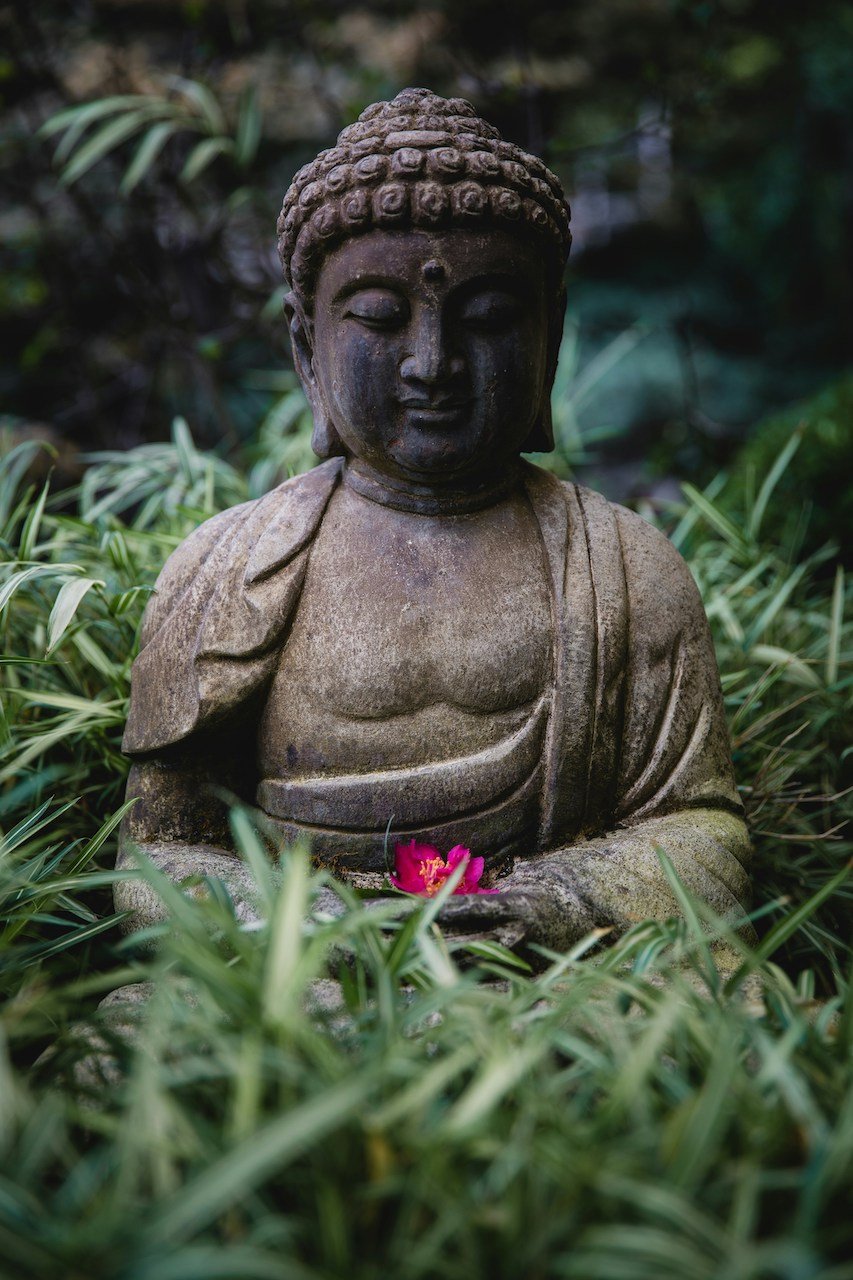

Good storytelling is all about showing rather than telling. Zen tradition presents the Buddha like the perfect storyteller. Instead of speaking and philosophizing about the truth, in the Zen tradition, the Buddha shows it, presents it to us, trusting that we will see the essence. Why this faith in us? Because he knew in person that he, we, and all beings, improbable as it may seem at times, are all fully and equally endowed with original minds of wisdom, compassion, and virtue. The only difference between Buddha and us is that we don’t know him yet.
Tendon koan Case 92 out of 100 Blue Cliff Record (C. Pi Yen Lu; J. Hekigan roku), one of Zen’s most central koan collections, the cosmic realization of the Buddha, born from the rarefied air of India, is transformed through the eyes of Chinese Zen into something direct and down-to-earth. It’s short and goes like this:
One day, the World-Honored Man took his seat on the platform. Manjusri struck the table with his hat and said, “Understand the Dharma King’s dharma clearly; the Dharma King’s dharma is like this.” The World Honored One got down from his seat.
Still, as short as it is, this koan has its challenges. What is Manjusri, the Bodhisattva of Wisdom, the teacher of the last seven buddhas, talking about? What is the Dharma King’s Dharma? And why is Manjusri speaking when the World Honored One, the Buddha himself, is sitting right there? Also, why does the Buddha remain silent and then simply step down from the teaching chair after Manjusri speaks? Did you have an earlier appointment? Did you indicate your approval – or disapproval? What kind of dharma is this?
In this koan, the Buddha does not say a word or do anything. He gets up on the seat, sits down, hears a few words from Manjusri, then gets down and leaves. Rather shocking. Why is this in there? Blue Cliff Record– “as if it were so wonderful” – a quote from Master Wu-men’s commentary on the sixth case A barrier without a gate (C. Wu-men kuan; J. Mumonkan), another central Zen koan text entitled “The Buddha Holding a Flower”.
In this koan, instead of giving an enlightening dharma discourse to the assembled multitude, the Buddha simply holds a flower. And all that happens in the koan is that of the many disciples, arhats, bodhisattvas, gods, ordinary men and women who have gathered to hear the Buddha speak, only one person smiles. And the Buddha, seeing this smile, says that he is now giving his dharma to this one person, the Venerable Mahakasyapa. In his commentary on the case, Master Wu-men, the compiler of the cases, the author of the commentaries and poems. Barrier without gate, He says, “The golden-faced Gautama is certainly outrageous. He turns the noble into lowly, sells dog meat advertised as mutton, as if it were so wonderful.” With his tongue in his mouth, he says, “What is so wonderful about this trivial act of holding up a flower instead of speaking dharma?” Yet, at least in that incident, it is actually the Buddha he did something, no matter how minimal: holding up a flower and then saying words of praise to make the only person in the congregation smile.
But in our present case, Manjusri says a few words and Buddha just gets up and walks away – which doesn’t even qualify as dog meat advertised as mutton, but simply a nothing burger. Then again, nothing can happen something. Lord Buckley, a wild, jazz-surrealist storyteller of the late 1950s and mid-’60s, had a great riff on the conquistador Cabeza de Vaca, who was shipwrecked off the coast of Texas in 1529 and lost everything, including himself. After that, he became a healer among the native people of the Southwest. Later, however, after returning to Spain and regaining his usual identity, he lost this remarkable ability. At one point, Lord Buckley quietly says, “To have nothing, you must have…” before screaming, “Nothing!” And with that, everything – even ourselves – for the moment past! It’s his nothing enough something! You have to laugh, you are so surprised.
When Emperor Wu of China did not understand the meaning of Bodhidharma (the first ancestor of Zen in China, 28th in line from the Buddha), who answered his question about the highest teaching, “Immense emptiness, nothing can be called holy,” Bodhidharma, very similar to the Buddha in this koan, simply walked away. Which is at least a response to the emperor’s lack of discretion. In the koan quoted above, Manjusri and Buddha understand each other well. Yet the Buddha simply steps down from the teaching platform and walks away. What did those who gathered to hear his dharma think? (Though not mentioned, they were there; after all, Manjusri is talking to him someone.) Designed by Buddha and Manjusri? Was Manjusri the only one who could understand? Yamada Roshi (teacher of Robert Aitken Roshi) offers helpful words about Manjusri, the Bodhisattva of Wisdom.
Manjusri was a Buddha who returned to the rank of Bodhisattva to save others… (and) known as “the teacher of the Seven Buddhas”, the Buddhas of the past whose ranks include Shakyamuni….
Manjusri is also a symbol of enlightenment. To become a Buddha, one must pass the level of bodhisattva, and that means attaining enlightenment. Since no one has attained Buddhahood without attaining enlightenment, this is why Manjusri, the symbol of enlightenment, is the teacher of all buddhas. Although he takes the form of a bodhisattva, he is not at all different from the actual buddha…
Unpublished comments on: Blue Cliff RecordKoun Yamada
(If you are interested in Manjusri, you may enjoy my book The Zen Lives of the Bodhisattvas (Sumeru, 2023), which has several chapters on him and his role in Zen.)
There is another well-known Zen incident that is even closer to the short koan of the Buddha descending from his teaching seat. Fu Daishi, an enlightened layman in China some 1,000 years after the Buddha, also left the same emperor stunned. John Wu (in The Golden Age of Zen) says that Fu layman, born in 497, was “one of the most extraordinary figures in Buddhism and an important forerunner of the Zen school”. When Emperor Wu invited layman Fu to lecture a Diamond SutraFu Daishi simply walked up to the teacher’s platform, tapped the table with his katsu (the small curved staff – a symbol of teaching authority) and stepped back – leaving the Emperor stunned. Koan case 67 of Blue Cliff Record he continues the story, adding that when the emperor confessed that he did not understand, Master Chih replied, “The great bodhisattva has thoroughly explained the sutra.” And here it is. THE Diamond Sutra he says, “Like a cloud, a dewdrop, a dream, a fantasy, a lightning, we should look at everything like that,” Layman Fu explains so eloquently. Which in our present case seems almost identical to the actions of the Buddha. But is it?
Case 25 Blue Cliff Record– “The master of the lotus flower peak holds up his staff” may provide some insight.
The master of Lotus Flower Peak held up his staff and showed it to his disciples, saying, “When the ancients got here, why didn’t they stay?” There was no answer from the congregation, so he answered for them: “Because it is of no use in everyday life.” And again he asked, “What are you going to do with it?” And again he himself answered for them: “Not caring about others, I put my staff on my shoulder. I go straight ahead, into the hollows of countless peaks.”
After enlightenment, the Buddha sat completely still, completely at peace, completely realized under the Bodhi tree. He didn’t stay there, though. He arose, sought out five of his former ascetic disciples, and began a lifetime of teaching, sharing what he found and the path leading to it.
For those interested in following the path of the Buddha, pilgrimage to the sites of the historical Buddha’s life was an important religious practice. As Zen teachers encourage it, they also remind us that our fundamental pilgrimage is the path to the realization of our own mind. And while this mind is never far away, paradoxically awakening to it requires persistence and effort. Buddha’s awakening was the basis of his teaching, because it alone dissolved the painful consciousness of impermanence. The same realization that brought peace and joy to the Buddha is available to all of us. Because we are who we are, it remains the living core of the Buddha-way and the ongoing practice-realization tradition of Zen.
The Sanskrit word for samsara which literally means “wandering”, our lives are perceived/created/experienced by a wandering, unfocused mind. What kind of world can we experience with a focused mind or even without a mind? Case 20 Serenity’s book (C. Congratulations Lu; J. Shoyoroku) offers:
Ti-ts’ang or Lo-han (J. Jizo) asked Fayen (J. Hogen), “What are you doing these days?”
Fayen said, “I wander at random.”
Ti-ts’ang said: “What do you expect from wandering?”
Fayen said “I don’t know”
Ti-ts’ang said, “Not knowing is most intimate.”
Fayen was suddenly enlightened.
What is this glass, flower, star, tree, river, person, if we get rid of our accumulated guarantees, our related “knowledge”? How wonderful, even profound, each speck of dust can be. Not knowing there is most intimate, “intimacy” is another traditional word for realization or enlightenment. One of Blake’s now-famous poems (essentially unknown in his lifetime, considered a fool or madman—except by the handful of artists and patrons who respected and even revered him) reads:
Seeing the world in an eye of sand
And heaven in wildflowers,
Hold infinity in the palm of your hand
And an hour later, eternity.“Wings of Innocence” by W. Blake
Intimacy, indeed! Prajnaparamitathe the perfection of wisdom, he says, “form is only emptiness, emptiness is only form.” Blake, all alone, based on his own experience, wrote: “Eternity is in love with the creations of time.” (“Proverbs of Hell”, The marriage of heaven and hell.)
The fundamental path of this life, the hero/heroine’s quest, is the path from isolation to intimacy. It’s a matter of coming home. This fundamental pilgrimage shapes the contours of our lives and takes shape in the challenges, frustrations, annoyances, joys and decisions of our daily lives. Consciously lived, this life as it is can take us from ignorance to wisdom, from self-centeredness to altruism, from immaturity to maturity, from wandering to homecoming. In the koan of the Buddha ascending and descending to the teacher’s seat, two pilgrimages meet. By meeting the Buddha, we establish faith in the reality of his teaching; by meeting ourselves, we gain the confidence to live the truth that we have found to be our own.
However, the baited hook of this koan remains firmly attached. What is Manjusri, the Bodhisattva of Wisdom, talking about when, like some raucous carnival barker, he insists that the Dharma King’s dharma like this? And why, once he declares it—as if it were so wonderful—does the Buddha simply stand up and walk away?
What teaching is this? How can this make us happy?
♦
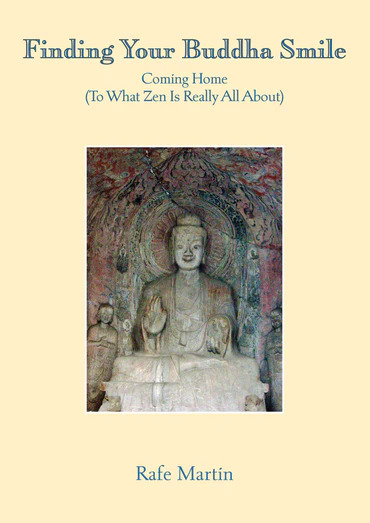
adapted from Finding Buddha’s Smile: Coming Home (to What Zen Is Really About). © written by Rafe Martine. Reprinted with permission from The Sumeru Press Inc.