
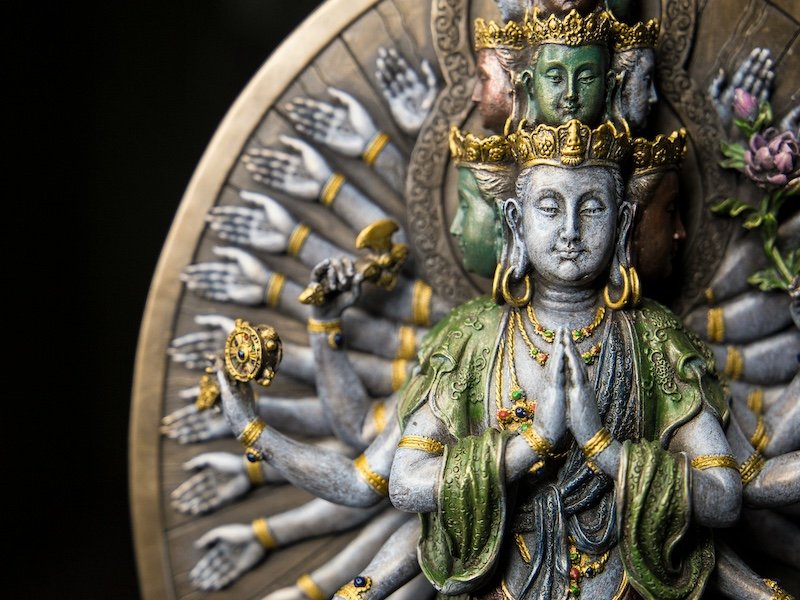

Today, all of us, but especially we Americans, face so many challenges that the “three poisons” of greed, hatred, and ignorance are shamelessly spreading in our country and in the world in general. It can be overwhelming. What should I do? How do we move forward when every day brings new and terrible challenges? It’s hard not to despair. But turning to the Bodhisattva The Great Compassion can give us heart and help us see that we are not alone.
But first – a few words about Buddha. Twenty-five hundred years ago, after about six years of devoted effort, the former prince Siddhartha Gautama fully awakened to full and perfect enlightenment. According to the legend known at the time as the Buddha, the Awakened One, when he became enlightened, he spontaneously exclaimed: “Wonder of miracles! All beings are now Buddhas, fully endowed with wisdom and virtue. Only the unconscious habit of dualistic, self-centered thinking prevents this from happening!” Then the experience was so powerful that for three weeks, it is said, he continued to sit under the Bodhi tree, absorbing the depths of this realization. He wondered if the truth, now so obvious and yet so subtle, could be communicated. But then, convinced by the gods themselves, he got up and set out on the dusty roads of India for a lifetime of teaching others how to find and walk the liberating path he had discovered.
Why? Why is it worth embarking on the challenging path of helping others after realizing true peace? A Buddhist parable says that the Buddha was once sitting in a grove when he asked the sangha, “Are there many leaves covering the earth here, or are there few?” The sangha replied, “Many letters, World Venerable One.” Then he held up a handful of leaves and asked, “Am I holding a lot of leaves now or a few?” “Very few letters, World Honored.” The Buddha said, “What I have realized through enlightenment is like many leaves. But what I teach is like this small handful. Because what I teach is only what helps to end suffering.” His basic goal, the result of his great enlightenment, was to benefit all beings.
***
The word “love” is rarely used in Buddhism and hardly mentioned in Zen. But if you lean in close, you’ll hear his silent voice. William Blake—our wise old man of the West—hit the nail on the head when he wrote: “Eternity in love with the productions of time” (The marriage of heaven and hell). Avalokiteshvara, the 1000-armed Bodhisattva of Great Compassion, is the active form of immense and completely selfless, non-dual love. Such love is not mere emotion. Each of the bodhisattva’s thousand arms ends in one hand, with the open eye of awakened, transcendental, non-dual wisdom in the palm. Without this open eye, who knows what damage can be caused by a thousand sincere but blindly groping hands? The bodhisattva also has eleven heads, so he can see into all realms. How did it all happen? How did he, or she, or they get that many heads, arms, and eyes? Was it a matter of wishful thinking – or what?
Buddhist legend tells it like this: Worlds ago, the great Bodhisattva of Compassion, Avalokiteshvara (who is usually depicted as male, although the Chinese Kwan Yin and the Japanese Kannon are usually female) looked down into the many hells and saw them filled with suffering beings. A great vow was made: “I will free all beings from the sufferings of the lower realms.” Then he worked through countless ages, descending into hell after hell, emptying hell after hell. Finally, the unthinkable was accomplished. The hells were empty. All living beings are freed from suffering.
The bodhisattva wiped the diamonds of sweat from his forehead and looked down into the now empty, silent hell with deep satisfaction. And he smiled. Done, done, done. Here and there a wisp of billowing smoke still rose; every now and then in some great cave far below there would be faint echoes as a brick fell from a pile of rubble. But the raging fires were extinguished, and the great bubbling iron cauldrons were stilled. Sweet silence permeated the dark halls. Even the raging demons were gone; the horse-headed, the tiger-headed, the deer-headed and the fang-headed. Finally, they too were set free by the great efforts of the compassionate.
But suddenly there was a scream, then another. Flames shot up, smoke swirled, cauldrons full of blood bubbled madly. Whips cracked, chains rattled, demons roared. The radiant smile faded from the bodhisattva’s face. In less than an instant, everything was as it was before, the hells were once again fully loaded. The bodhisattva’s heart was filled with the deepest sadness. His head broke into eleven heads. His arm shattered into a thousand arms. With eleven heads, the bodhisattva could see in all directions and find all suffering beings who needed help. With a thousand arms, he could reach into any realm to offer assistance. The great bodhisattva raised his thousand fingers and settled down again to the endless task.
Completely committed, hard-earned failure, great despair did not result in withdrawal, denial or giving up, but rather greater commitment and greater skill. As Wu-men in his A barrier without a gate (C. Wu-men kuan; J. Mumonkan) collection of koans says in a slightly different context: “Failure is indeed wonderful.”
Zen holds that the compassionate efforts of a bodhisattva are like someone trying to fill a well with snow. Throw in endless shovelfuls of snow, and as each one hits the water, it immediately begins to melt. The task is hopeless, impossible. And yet therein lies the essence of the Bodhisattva Path. Just as the Sanskrit word ‘bodhi’ means ‘wisdom’ and ‘sattva’ means ‘being’, bodhisattva literally means ‘wisdom being’. So a bodhisattva is a being who has been wisely chosen to grow beyond his own unconscious self-centeredness and benefit all. Leonard Cohen wrote: “Now I greet you from the other side / Of sorrow and despair / With a love so vast and broken / It goes everywhere” (“Heart with No Companion”). Isn’t that right? Is this not Avalokiteshvara Bodhisattva’s voice, is he or is he their self?
The Buddhist tradition summarizes the Buddha’s teaching in three general resolutions: “Avoid evil. Do good. Save many beings.” In a well-known Zen dialogue, one of China’s great poets, who was also the governor of a province, came to Bird’s Nest Roshi (so named because of his habit of doing zazen on a tree) and asked him for the highest level of teaching. The Bird’s Nest replied, “Avoid evil, do good, save many beings.” The sophisticated governor replied, “Even a 3-year-old child knows that.” To which the Bird’s Nest replied, “Yes. But a 70-year-old man is still difficult to implement in practice.”
It is really difficult to implement in practice. Difficulties are coming. Failures may come, but challenges can lead to greater commitment and greater skill. After all, this is how the Great Bodhisattva got all those hands, eyes, and mouths to speak up for good and speak out against evil. We, novice bodhisattvas, will do the same. Then we roll up our sleeves and get back to work filling a well with snow.



