

“Anxiety is not the enemy, but the messenger. The mistake is to kill the messenger instead of reading the letter.” ~ Unknown
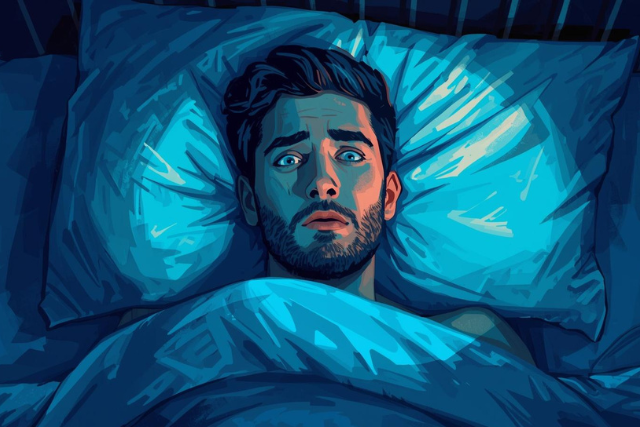
It’s 3am, I’m lying in the dark planning my own funeral.
Not because there’s anything wrong. My family is safe. There is no emergency. But my brain decided with complete confidence that this afternoon’s headache was fatal. I’m already thinking about who’s coming. He will cry. Who will move faster than I want.
An hour earlier, the same brain had decided that my career would end. I have a presentation tomorrow – and I was already standing there in my mind, forgetting every word, watching my boss slowly shake his head. Before that, a friend of mine didn’t respond to a message I sent at noon. By two in the morning, the friendship was over. He hated me. Everyone hated me. I did something unforgivable that I don’t even remember.
That’s what the night does. It takes small things and turns them into certainty. He gets a headache and turns it into a tumor. It requires silence and rejection. He creates disaster almost out of thin air with extreme creativity and zero mercy.
For years I thought there was something wrong with me.
I was wrong about that.
Here’s the thing no one tells you about 3 a.m. anxiety: Your brain isn’t malfunctioning. It does exactly what it was designed to do. And once I understood—really understood—everything changed.
Think about where we come from. For most of human history, darkness was indeed dangerous. Predators moved at night. Enemies came in the dark. The people who calmed down after sunset, who trusted the silence, who let go of their madness – they didn’t live long enough to become our ancestors. Those who succeeded stayed awake. Who was looking for threats. Who imagined the worst and prepared for it.
Those people had children. Those kids had kids. Finally, one of them was me, lying in a safe room in a city with locks on the doors and no predators within a thousand miles—and a brain still running the same ancient software, looking for danger, because danger is its whole purpose.
The lions are gone. The brain doesn’t know that.
So you find new lions. An unanswered message. A headache. A presentation. It takes what’s available and turns it into a threat worth staying awake for. Not because he wants to torture you. Because he loves you, the only way he knows how – which is to protect you from every possible thing that could go wrong.
That was the first thing I had to learn: anxiety is not a 3am attack. This care in its broken, ancient, useless way.
The second thing I had to learn was more difficult.
A real disaster and an imaginary disaster feel exactly the same at 3am
A competitive heart. Hands are cold. It’s stomach-churning. All this – all physical symptoms – are caused by thoughts. Just thoughts. Images in the mind that do not exist anywhere else. Yet the body reacts as if the threat were in the room.
If you now vividly imagine biting into a lemon, your mouth will produce saliva. The body cannot distinguish between reality and intensely imagined. This is not a mistake. This is the characteristic: the brain prepares the body for what the mind thinks is coming.
So at 3 a.m. I was expending real adrenaline, real cortisol, real physiological resources for events that were never going to happen. By morning, I was exhausted before the day started. Not from what happened, but from what I imagined.
The ones I feared almost never arrived. And the real difficulties—the ones that came that actually changed my life—almost never came from the direction I was looking. I was prepared for bad disasters. The real ones came quietly, from places I never thought I would guard.
I tried many things to stop it. Breathing exercises. Counting. Meditation apps with calm sounds to help me relax. Sometimes they worked. Mostly they didn’t. Because I was approaching anxiety like an enemy to be defeated, and you can’t defeat something by fighting harder against it. The resistance itself becomes exhausting.
What ended up helping me was something much simpler and much weirder. I stopped trying to stop him.
Not in defeat. Not in resignation. But in recognition. The thoughts came—they always did—and instead of arguing with them, instead of trying to replace them with better thoughts, I just started to watch them. Let’s let it run. Treat them as you would a very worried friend who is convinced something terrible is about to happen: with patience, without compromise.
The thought would say: this headache is something fatal.
And instead of fighting it, I’d think, “Yeah, I hear you. That’s a scary thought. Let’s see if it’s still true in the morning.”
The thought would say, “Your friend hates you.”
And I’d think, “That’s possible. We’ll find out. There’s nothing we can do about it right now.”
This created what I can only describe as a small gap – a gap between me and the story my mind was telling. I was no longer in the disaster movie. I was looking from somewhere a little outside. The disasters were still playing out. But they lost some of their power over me.
There is one more thing. A small truth that I try to remember in the dark. Right now, at this moment, there is nothing wrong.
Not tomorrow. Not next week. It wasn’t the abstract futures that my mind was so convinced of that were ruined. Right now. This moment. There is a dark room. Quiet house. A body that is warm and safe. And really, that’s all that’s real.
The future is imagination. The past is a memory. Only now it’s real. And now—almost always, if you look at it directly and honestly—it’s okay.
It does not empty the mind. Nothing clears the mind. But this creates that gap again. Enough room to breathe. Sufficient distance to wait.
Because the morning always comes. It’s the only thing you can absolutely trust at 3am. It always, without exception, ends.
The tumor becomes a headache. A broken friendship becomes a friend who was busy. Career collapse will be just another Wednesday. And you look back at what seemed so certain in the dark and understand—not with shame, but with something closer to compassion—that your brain was trying. He works hard. He performs his ancient task in a world that no longer needs him.
He doesn’t know that the lions are gone.
He just knows he loves you.
The next time you’re awake at 3 a.m. convinced of a catastrophe that seems totally real and totally certain, try not to fight it. Try looking at it for a moment instead. Notice what the brain is doing. Realize that you are still here, in a safe body, in a quiet room.
Thank the worried part of you, even briefly, for trying so hard.
Then wait for the morning.
It’s already on its way.
And you—anxious, exhausted, awake at 3 a.m.—are not broken.
You’re only human. Doing the most humane thing possible.
Waiting for the light.

About Selim Hayder
Selim Hayder writes essays about memory, grief, identity, and the unspoken parts of human existence—anxiety, silence, time, loss, and what it means to exist in the gap between who we are and who we show the world. No advice. There are no answers. Just honest writing that explores what it feels like to be alive. More here: haydervoice.com.