
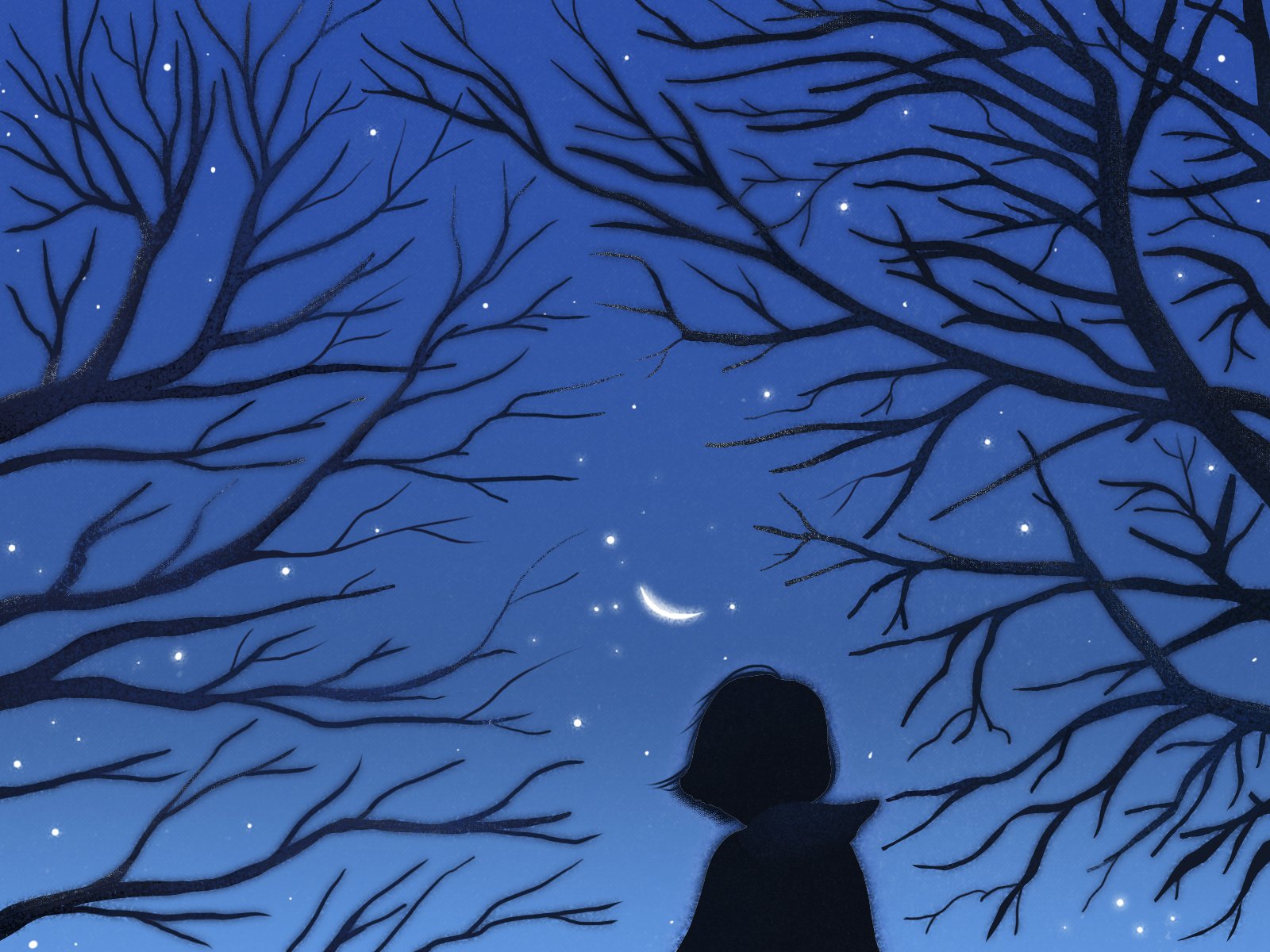

Because they appear during the coldest, darkest months of the year, winter stars have a distant, austere beauty that prompts us to ponder the great themes of literature—such as love and loss, birth and death, and the longing for eternity. Not surprisingly, last month’s winning and honorable mention haiku all dealt with the passage of time.
- Gregory Tullock reveals the dark history of two cultures in his poem about mountain ranges connected by the “same winter star”.
- Stephen Billias captures the wonder of starlight “born many distant kalpas ago” that finally reaches him on a winter’s night
- Matt Osmond he realizes that nothing lasts forever—not even the winter stars, which “shine long after they’re gone.”
Congratulations to everyone! To read more merit poems from past months, visit our Tricycle Haiku Challenge group on Facebook.
You can submit a haiku for the current challenge here.
Winter season Word: Winter star
WINNER:
in Appalachia
or in the sky of Hokkaido
the same winter star
—Gregory Tullock
The English writer and translator RH Blyth once described haiku as “an open door that appears to be closed.” Not windy open. But not closed either. Left open and slightly ajar, only a slight push is required for the door to open and the reader to enter.
In the best haiku, the hinge of this “door” is neither rusty nor oiled. It should be easy to open, but it isn’t too easily. Imaginative play is part of the process, but it shouldn’t happen all at once. A good haiku has multiple layers of meaning that reveal themselves as you read the poem later.
Our winning haiku from February 2026 is a good example of this. The images consisting of two place names and a star are so bare that at first we may not even know what to do with them. The open door appears closed.
Appalachia refers to the mountain range in the eastern United States from Georgia to Maine, while Hokkaido the northernmost landmass of the eight islands that make up Japan. The topography of the island is mountainous, so the poet probably wants to imagine the harsh, distant topography of the two regions.
The fact that the “same winter star” is visible from both regions suggests a panhumanist perspective. We may belong to different countries and cultures, but in essence we are all the same. The star is a symbol of our common humanity. But something interesting happens when we consider which star the poet might be referring to.
Given how few celestial bodies modern humans can recognize by sight, the most likely candidates are Sirius (the brightest star in the sky) or Polar (the Pole Star), both visible throughout the winter in the Northern Hemisphere. But the difference is profound.
Sirius, which is part of the constellation Canis Major, is only visible in the winter, while Polaris remains in place year-round – so its symbolism is extremely consistent across cultures. It represents standing, guidance, and the hope of achieving a goal or ultimate goal.
If the “winter star” in question refers to Sirius, the poem is associated with the season of cold and darkness. His tone is therefore somewhat gloomy. When it comes to Polaris, the star is a symbol not only of our collective human experience, but also of our species’ journey through deep time.
For the non-Japanese reader, it may take a while for curiosity to kick in and to begin to wonder about the history of Hokkaido – the last of the eight islands to be settled by people from mainland Asia who displaced the natives. Jōmon The population of Japan.
According to Jared Diamond, the author Guns, Germs and Steelthe Jōmon The population of the eight islands was only around 75,000 when these migrations began in the first millennium BC. As millions of people arrived from Korea and China, their genetic and cultural identities were quickly surpassed. Hokkaido held on until the 18thth century, when the indigenous Ainu people were colonized and forcibly assimilated into Japanese society. Their language can now be considered extinct, and they are not known in their mother tongue.
It takes little imagination to connect the deep history of the two places mentioned in the poem. Until recently, both were inhabited by indigenous peoples who had lived there since the Upper Paleolithic. The star – Sirius or Polaris – remains a silent witness in the winter sky above both regions. But everything else has changed. I read this simple, remarkably understated haiku as a poem about unspeakable loss, what it means to be human, and the unfathomable mysteries of deep time.
TRIBUTES:
winter starlight was born
a lot of distant, distant past
it reaches me now
– Stephen Billias
None of us survive
the winter stars still shine
long after they were gone
– Matt Osmond
Winter season word: “Winter Star”
one learns to explode
inwardly and silently
like a winter star
After reading the news, I felt down, so I went outside to look at the sky. The winter stars found out. They can explode without flying apart. – Clark Strand
Submit as many haiku as you want for the seasonal word “winter star”. Your poems should be written in three lines of 5, 7, or 5 syllables respectively, and should focus on a single moment that just happened.
Be clear in your description and try to limit the topic. Haiku are almost always better if they don’t have too many ideas or images. So focus on the soy of the season* and try to stay close to that.
* REMEMBER: To be eligible for the challenge, your haiku must be written in 5-7-5 syllables and contain the words “winter star”.
Haiku tip: Write with feeling!
How much emotion is allowed in a haiku? The short answer is “as much as you can get away with”. The trick is knowing who it’s for.
Strictly speaking, a haiku no longer belongs to the poet once it has been sent out into the world. This is true of all poetry to some extent. But this is more true of haiku. Haiku lives in the thoughts and feelings that unfold from the bare little snippets of a poem. The poet gives only 17 syllables. What the reader experiences is a world.
In this case, the poet’s job is to write with feeling while not getting into it beat from these feelings. . . to suggest a world while not getting into the beat from that world. Therefore, most of what the poet puts into a haiku will be implied rather than spoken.
So how do we write with feeling? Over the centuries, poets have offered advice on how to write from the heart. Bashō considered it important to leave room for the reader to feel the essence of the poem. According to Shiki, emotional content should be expressed in objective images. And Issa confessed everything and told the truth about her life. However, everyone agrees on one thing: a haiku is not a haiku without emotional truth at its core. Poets always strive for this, even if they get there by different paths.
One note winter stars: Season’s Word Editor Becka Chester writes about this month’s theme: “During the winter months in the Northern Hemisphere, our view is beyond the periphery of the Milky Way, with far fewer stellar bodies between Earth and extragalactic space. The air is drier at night in winter, so there is less moisture in the atmosphere. The stars are clear and intense.
“In Haiku worldWilliam J. Higginson writes of the winter stars: “The clearness and coldness of the winter sky brings the stars closer.” During this season, the deciduous trees are leafless, so we see less of the sky. And because the nights are longer, we have plenty of opportunities to look up at the stars.”



