

The following excerpt comes from Shoukei Matsumoto Work Like a Monk: A Buddhist Guide to Embracing What Matters. Written as a dialogue, exchanging words with two people and listening deeply, this excerpt shows Matsumoto’s insights learned from real-life encounters and the working people he encountered as a Sin Buddhist monk.
I was probably in elementary school the last time I swept up fallen leaves with a bamboo broom. In Japan, everyone from elementary school to high school cleans together every day, which I always thought was a good practice.
“The Japanese traditionally give thanks for cleaning. One is to remove kegare (Jp; impurities)as in dirt, but also replaces kegare on another, as in low energy. It’s about really paying attention and caring for others and ourselves.”
I remembered how the relationship between the Japanese and cleaning had been emphasized worldwide. In one such incident, after a soccer World Cup, Japanese fans were shown cleaning the stadium seats on their own initiative. It was explained as “good Japanese manners” to the watching global community, but I suggest it was not just out of politeness. It was more like a greeting, an expression of gratitude for being there and sharing the moment with everyone.
“Cleaning is also a way of connecting to the place. When you clean a space, it becomes sacred to you. For the fans who cleaned the stadium, this place always has a special meaning. When we take care of our environment, we build a relationship with the space itself and, as a result, with every single element we handle.”
I was amazed at how well maintained Japanese temples often are. Everything – rooms, wooden floors, old pillars – is kept in order and polished in daily efforts.
“Cleaning has long been an essential practice in Japan’s temples. Simply sweeping up fallen leaves and straightening up, starting from the nearest point, is already a sensible undertaking.”
I realized that this is also related to the awareness of being here and now.
“Our environment connects us to who we are. A cluttered environment can scatter our minds and pulls us away from the present. Grounding in the here and now means that we bring harmony to ourselves and the space around us.”
Cleaning brings me back to the present moment while creating harmony with my surroundings. Although I don’t mind cleaning, my room sometimes gets piled up when I’m busy, and I know a lot of people struggle with it.
“It’s normal to think, ‘Why bother? It’s going to be messy again.” But for us it’s cleaning in the church not simply removing dirt or creating a mess. It’s a daily habit that nourishes you we are aware of the interles, just as we are of the chanting or the salutation.”
Some people feel more comfortable in the midst of chaos. I asked the priest if we should aim for a certain standard.
“Existence simply is. It is our mind that classifies it as good or bad. If one finds peace in disorder, that is okay. ‘Order’ is personal. There is no ultimate goal.”
Watching the people cleaning around the temple, I noticed how refreshed and alive they looked.
“It’s a process you can enjoy creatively, not just a chore with a specific end point. It promotes self-reliance—literally, freedom.”
I suggested that some people hire a cleaning service or use robot vacuums and questioned whether there was anything wrong with relying on someone or something else.
“Nothing at all. Churches sometimes ask parishioners to help, or even use a cleaning robot. We live in a network of relationships. Work, raising children or caring for children can leave little time, and our bodies don’t always cooperate. Taking care of our environment together can be a joint effort, we use each other’s help when necessary.”
So even churches can have cleaning robots!
“What matters is that practice is different from mere duty. No one else can meditate for you; no one else can experience the ‘here and now’ for you.”
I suppose no one else can live my life for me in the same way.
“Even small actions matter – straightening the desk or cleaning the dishes. Everyday routines such as cleaning, find– conscious work that brings you and your environment into harmony at the same time.”
This explains why the temple priest always wears simple clothes find robes meant for everyday routines rather than special rituals.
Purity and humility
If cleaning is an exercise without a clear end point, what exactly is our goal? If we just move the leaves from one place to another, what does it achieve? Sometimes it seems that we impose human order on natural processes.
“In the past, when disasters or national crises struck, an imperial decree ordered people to clean shrines and temples. People believed that disasters happened because the places of deities and Buddhas were messy.”
I choose my words carefully. From a scientific perspective, I say that the second law of thermodynamics explains that molecular motion tends toward increasing disorder over time. Pour milk into the coffee, leave it alone, they will eventually mix. Without care, objects perish, disorder accumulates, and entropy increases. In our bodies, this can manifest as neglect, which can lead to tooth decay or infections. So, in a way, isn’t cleaning fighting against the natural progression of things?
“There’s a view. Cleaning is by definition artificial. Sometimes destructively—dramatic weeds, for example, are arguably violent towards other forms of life. But life itself is a step back against entropy; we maintain flow and balance in our body and mind by breathing, eating and renewing ourselves. The cycle of entropy and renewal is what it means to live and when balance is lost, death follows. In this sense, there is both positive and negative.”
There is a Japanese saying, “Darkness lies at the foot of the lighthouse” – meaning that if we focus too much on the distance, we may not be able to illuminate what is right in front of our feet.
So, although entropy is always happening, life perpetuates these continuous cycles that preserve order.
“Exactly. And that’s why cleaning teaches us humility. Our bodies and minds are intertwined we exist relying on nature and countless other forms of life. Recognizing these gifts—accepting the richness that sustains us—is beyond positive or negative.”
I know that cleaning is not just tidying up. But if it’s something this profound, I wonder out loud, where do I even begin?
“Right at your feet. When clutter piles up, we can’t see what’s in front of us—not even physically and in terms of our wider awareness. The more scattered our minds are, the more likely we are to miss what is important.”
There is a Japanese saying, “Darkness lies at the foot of the lighthouse” – meaning that if we focus too much on the distance, we may not be able to illuminate what is right in front of our feet.
Maybe it’s best to start here, step by step.
◆
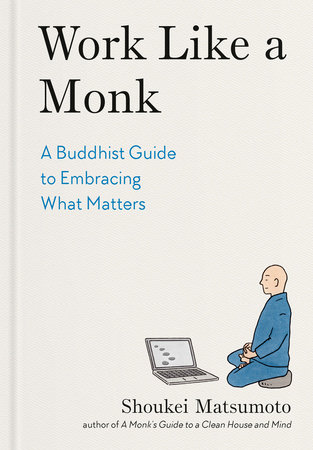
Reprinted from here Work like a monk by arrangement with Tarcher, a member of Penguin Group (USA) LLC, A Penguin Random House Company. Copyright © 2026, Shoukei Matsumoto.