
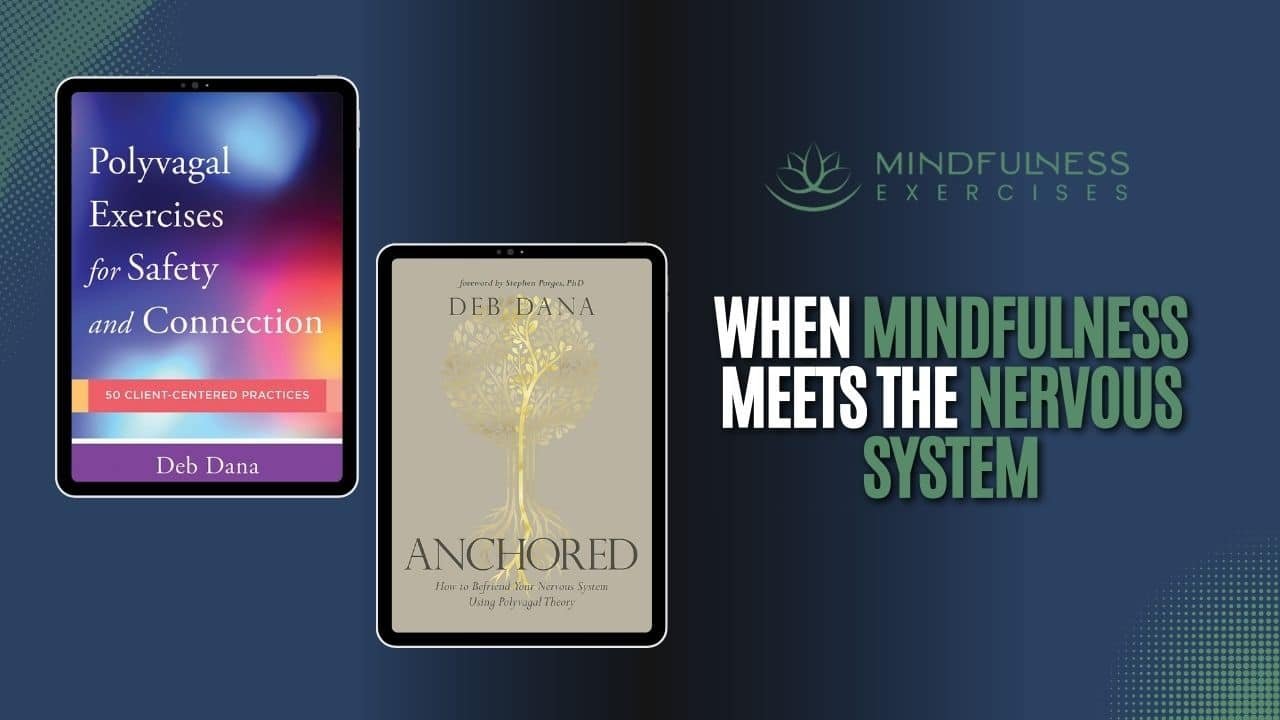

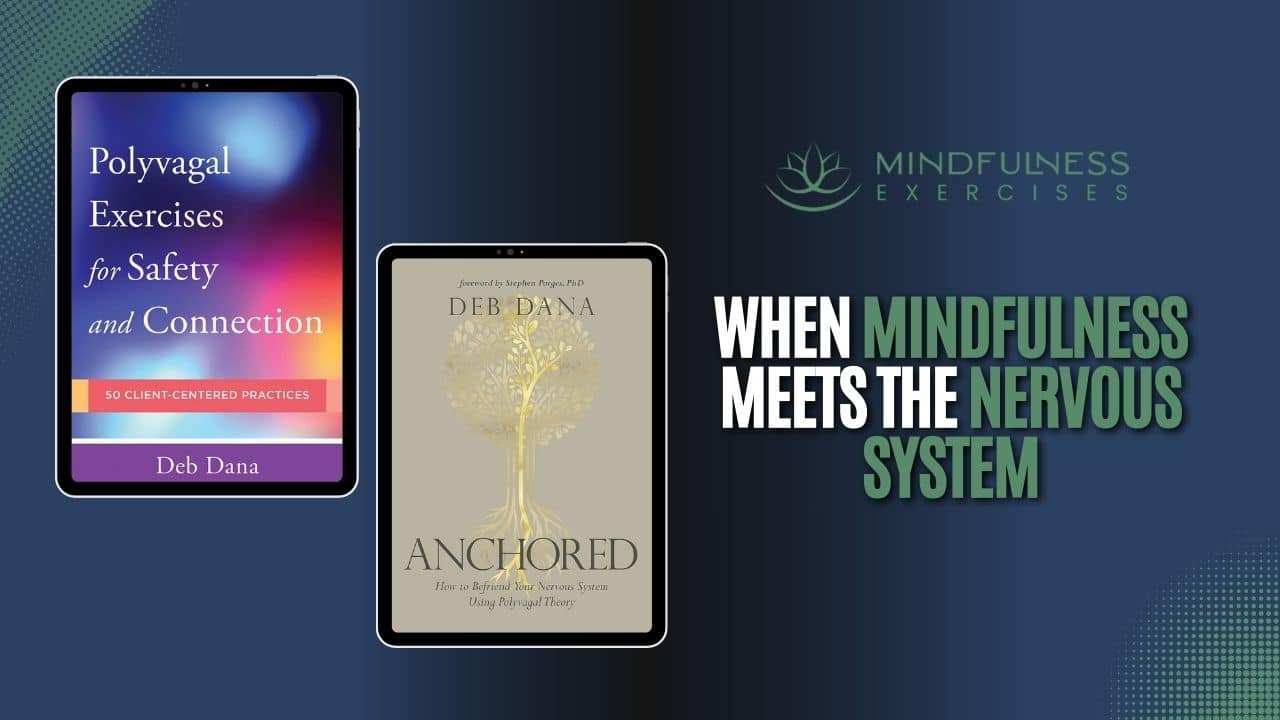
This week I’m sitting next to a couple of books that are quietly reshaping how I understand mindfulness—not by offering more techniques, but by helping me see. which the nervous system already does all day.
Author of both books Deb Dana:
What had the greatest impact was not just the exercises themselves. This is it reframing.
These teachings gently remind us that consciousness is not only in the head.
It lives in the body.
It lives in the nervous system.
Or as I say: Mindfulness is not intelligence.
The mind includes our entire sensory world—breathing, heartbeat, muscles, emotions, and the nervous system that holds it all together.
And when we understand what the nervous system is actually trying to do—move us toward safety, ease, and connection—much of our struggle with mindfulness begins to make sense.
Polyvagal Theory, in plain language
Polyvagal theory developed by a neuroscientist Stephen Porgesprovides simple but profound insight:
Our nervous system constantly asks a basic question:
“Am I safe?”
Based on the answer to this question, our body is organized into one of three primary states:
-
Ventral vagal: safety, connection, presence, openness
-
Sympathetic: mobilization, fight or flight, anxiety, urgency, anger
-
Dorsal vagus: shutdown, crash, numbness, disconnection
These are not our conditions choose.They are biological responses designed to support survival.
This is very important for the practice of mindfulness – since the qualities associated with mindfulness (curiosity, attention, compassion, persistence) are most naturally ventral vagal state.
Which leads to a key insight:
Mindfulness does not begin with being attentive.
It starts with this security.
Why doesn’t “just watch” always work?
Many of us have been introduced to mindfulness as an attention-raising exercise:
-
– Bring your attention to your breathing.
-
“Stay with the sensation.”
-
“Watch what’s happening.”
And when the nervous system already feels safe and regulated, it can be deeply supportive.
However, Deb Dana’s work clarifies something that many practitioners have felt intuitively for years:
When the nervous system is in sympathetic activation or back stopsustained attention feels like pressure, not presence.
You may have seen this on yourself or your students:
Someone sits down to meditate. They close their eyes. In no time, your system turns into anxiety, restlessness, or a foggy meltdown.
Then the mind adds a painful story: “I must be bad at meditation.”
From a polyvagal point of view, nothing wrong.
The nervous system simply does not feel safe enough to calm down yet.
The Polyvagal Reframe: Start with Safety, Not Effort
Polyvagally informed mindfulness changes the starting point.
Instead of asking:“Can I stay here?”
We ask:“What would help my nervous system feel safe enough to be here?”
This single shift can transform a practice from something we push through something we enter gently.
A simple ventrally inviting exercise
Before formal meditation, try to orient yourself towards safety:
- Feel your feet touch the floor
- Look around carefully and name some colors or shapes
- Notice a neutral or slightly pleasant feeling in your body
It’s not a warm-up, it’s not extra.
This is how we invite the ventral vagal system online – where mindfulness becomes available naturally.
Sympathetic and dorsal condition are not failures
One of the most sympathetic contributions of polyvagal theory is the way it reframes “dysregulation.”
-
Sympathetic activation it brings energy, alertness, urgency – it once helped protect, act and survive
-
Dorsal stop saves energy when escape is not possible – slows, numbs and protects from overload
Neither state is a mistake.
It is both intelligent adaptations.
When we try to meditate against these states – forced to rest, overwhelming fatigue, pressured into anxiety – often intensify the struggle.
When we recognize them, something softens.
A gentle mapping exercise
In meditation or in everyday life, feel free to ask:
-
“Does my body feel mobilized, relaxed, or drained right now?”
-
“Am I closer to sympathetic energy, back heaviness, or abdominal connection?”
No recording.
No fix.
Just a respectful observation.
That alone can reduce shame — and allow compassion to come back online.
Regulation is a rhythm, not a goal
The polyvagal theory reminds us that a healthy nervous system flexiblenot permanently calm.
Of course we move:
-
into sympathetic energy to act
-
to relax into dorsal energy
-
back into the ventral energy to connect
Mindfulness is not about staying regulated forever.
It’s about how to learn return – gently, several times, without force.
The real question is:
Not “How do I stay calm?” but “How do I find my way to safety and connection when I leave?”
It’s a skill. And it can be learned.
The nervous system learns through experience
One of the reasons Deb Dana’s work integrates so seamlessly with mindfulness is that she respects how learning actually happens in the body.
The nervous system does not regulate because we understand a concept. You regulate because you experience:
-
timbre
-
stimulation
-
choice
-
connection security
This strongly influences the management of practices.
We don’t have to specifically teach the polyvagal theory. I have to teach in a way that feels natural.
A gentle but powerful teaching shift
Instead of, “Bring your attention to the breath.”
Try: “If you feel supported, you can notice the breath—or any place in the body that currently feels even or neutral.”
The choice indicates safety. Security calls for presence.
Safety grows through anchors, not through peak experiences
Another polyvagal insight is its importance ventral anchors – small, reliable signals that help keep the nervous system safe.
Regulation usually does not come from long, perfect meditations, but from repeated moments it’s just easy enough.
A familiar voice. A pet nearby. A tree outside the window. A song. The memory of the reception.
A simple recording exercise
Ask yourself or others to identify a ventral anchor:
-
a person, place, sound or feeling
-
something that moreover 5% lighter
Check back often – especially when things are already in order.
This is how the nervous system learns that safety is available.
We teach regulation by regulating
Perhaps the most humbling truth of all:
It is regulated by the nervous systems together.
Before people hear our words, their bodies sense our state—our pace, our breath, our presence, and our voice.
If we rush, strive, or force results, it gets passed on.
If we are grounded, powered, and connected, it will also transmit.
Polyvagal theory does not require us to be perfect teachers.
He asks us to be honest some of them.
Before we direct others, we pause.
We will find out.
We feel our feet.
Not to behave calmly, but to live sufficiently safely.
A silent invitation
If you are a mindfulness teacher, therapist, coach or guide, these teachings are especially timely.
They are not a substitute for vigilance.
They help to land in the body.
They remind us that presence is not something we demand of ourselves or others.
The nervous system allows this if it feels safe enough.
Take it slow as you explore the job.
Try the exercises on your own body.
Notice how your teaching voice softens.
Notice how the sessions are less demanding – and more human.
And when in doubt, you can ask a kinder, more biological question:
“Do you feel safe enough—for me and for them?”
This is often all the nervous system needs.



