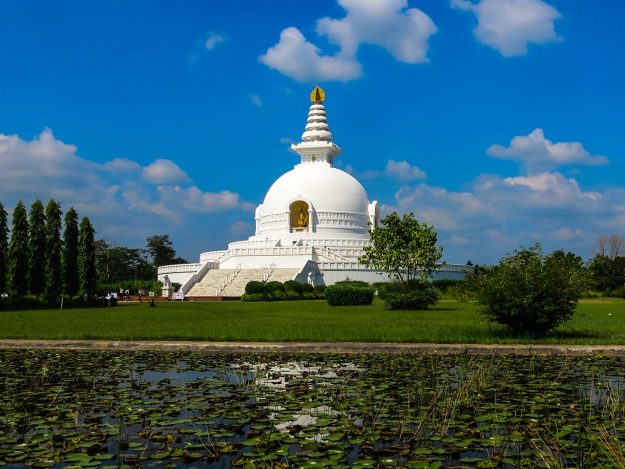
How many people know the name Nichidatsu Fujii (1885-1985)? Even those who don’t know its name have probably come across the large white stupas known as “Peace Pagodas” in cities like London, Vienna or Delhi, as well as in holy places in northern India and even the United States. Today, there are at least eighty Peace Pagodas around the world, including Japan. In addition, those who have participated in anti-war, anti-nuclear, peace, civil rights, racial equality, indigenous rights, and other nonviolent and social justice movements since World War II may have seen Japanese monks and nuns dressed in white and yellow robes and carrying purple banners with the Japanese characters: “Shelter in the Lotus Silk (Namu Myoho Renge Kyo), or they heard the sound of their podium and their prayer chanting.
A group of monks or sangha called Nipponzan Myohoji was founded in Japan by Nichidatsu Fujii. Nichidatsu, often referred to with respect and affection as “Guruji”, was a monk of Nichiren Buddhism and the leader of Nipponzan Myohoji. He started this religious movement to practice his teachings Nichiren (1222–1282), the founding monk of the sect, in modern society. Although the priesthood of Nipponzan Myohoji dwindled to about sixty monks and nuns in Japan and abroad, their number did not exceed one hundred even at their peak. Today, Nipponzan Myohoji clerics have no permanent temple or parish priest, do not accumulate wealth, and have no spouses or families, unlike almost all other Japanese Buddhist clergy. They live a simple life of poverty and strict discipline, cultivating themselves by practicing the teachings of Nichiren. Very few people in modern Japan know this group or Nichidatsu’s name. Nevertheless, he was a remarkable Buddhist monk who, during the 20th century, dedicated himself to spreading Shakyamuni Buddha’s teachings on nonviolence on the global stage. Constantly on the move, Nichidatsu dedicated his life to realizing a pure land of peace in today’s world. His non-violent activism has provided spiritual support to many involved in non-religious peace movements around the world.
If diplomacy is the effort to promote friendly and peaceful relations between peoples and nations through the use of moral principles and law rather than military force, then Nichidatsu’s efforts to achieve world peace through the Buddha’s teachings embody the essence of Buddhist diplomacy for all mankind. At the age of 93, in 1978, Nichidatsu was awarded the Jawaharlal Nehru Award for International Understanding by the Government of India. Other notable laureates include U Thant (1965), Martin Luther King Jr. (1966), Mother Teresa (1969), Nelson Mandela (1979), Aung San Suu Kyi (1993), and Angela Merkel (2009). This prestigious honor highlights the high regard for Nichidatsu’s achievements in India and around the world.
Nichidatsu was born on August 6, 1885, at the dawn of Japan’s transition from three centuries of national isolation imposed by the Edo Shogunate to an era of modernization and openness to the world. He was the son of a poor farming family living at the foot of Mount Aso in Kumamoto Prefecture, and his mother was a devout Buddhist. He enrolled at Usuki Agricultural School in Usuki City, Oita Prefecture to learn modern farming techniques. However, after reading it Representatives of Japan Through Uchimura Kanzo (1861–1930), a Christian educator and advocate of modern thought, Nichidatsu encountered the teachings described in Nichiren’s book and decided to become a priest. At the time, Japanese Buddhism was still struggling to re-emerge from the movement to “abolish Buddhism and destroy Buddhist images” in the 1870s and find its legitimate place between emerging militant nationalism and the emergence of state Shintoism. Nichidatsu was ordained at Hoonji, a temple of the Nichiren sect, but began to study the teachings of other Buddhist sects, including Pure Land, Shingon, and Zen. After rigorously undergoing ascetic practices such as waterfall asceticism, burning incense on his body, and fasting, he based his religious activities on the teachings of Nichiren. He was particularly inspired by “Establishing the Right Teaching for the Peace of the Earth”, which states that a country can find peace through true Buddhism. At that time, he began the practice of “beating the drum and declaring the teaching”, spreading the teaching. Lotus Silk to control people through the sound of the drum, as Nichiren had done throughout his life.
At that time, he began the practice of “beating the drum and declaring the teaching”, spreading the teaching. Lotus Silk to control people through the sound of the drum, as Nichiren had done throughout his life.
During this period, Nichidatsu began his missionary work in China – known at the time as “the spread of Buddhism on the continent”. Amid the Japanese military invasion of northeastern China and the establishment of the Japanese puppet state of Manchukuo, Nichidatsu traveled alone across the Korean Peninsula, northern China, and Manchuria, enduring harsh conditions. During this time he founded Nipponzan Myohoji and built modest hermitages as a base for his practice. In 1930, after his mother’s death, Nichidatsu vowed to “spread Buddhism to the Western Heaven”, with the goal of bringing Buddhism back to its birthplace of India and spreading it throughout Asia. He traveled to India and arrived in Calcutta, where he set up a small hermitage near a crematorium. After further pilgrimages, he promised to restore Rajgir, where the Buddha had stayed for an extended period to teach Buddhism to his disciples, and built a practice hall there.
A significant turning point in the development of Nichidatsu’s movement occurred when he met Mahatma Gandhi in 1933. During his stay in India, Nichidatsu visited Gandhi at the Wardha Ashram and spent two months there. Although he had only a brief official meeting with Gandhi, they developed a close relationship. This encounter had a profound effect on Nichidatsu, who was closely associated with Gandhi’s philosophy and practice of nonviolent resistance in the struggle for India’s independence. Nichidatsu was drawn to Gandhi’s simple, self-sufficient lifestyle, exemplified by his use of the spinning wheel as a symbol of liberation from colonial economic control and the materialism of Western modernism. He was also shocked that Gandhi, as the intellectual pillar of India’s independence movement, gained support from all over the world, including from the West. These experiences gave Nichidatsu confidence and direction in his pursuits.
A particularly memorable moment occurred during their meeting when Nichidatsu beat the hand drum and chanted Namu Myoho Renge Kyo. Gandhi joined in, beating his drum and chanting along. From then on, Gandhi developed a love for drums and incorporated drumming and chanting into the daily prayer ceremony at Wardha Ashram. Nichidatsu later wrote that the sound of the drums and their mutual joy created a deep connection in a moment of spiritual celebration. Gyakkusenryo– he drummed and announced the teaching. This experience enabled Nichidatsu to deeply recognize the connection between the Buddha’s teachings on nonviolence and Gandhi’s philosophy of nonviolence. Even today, Wardha Ashram practices drumming and chanting during daily prayer services. Around the same time, during his pilgrimage to Sri Lanka, Nichidatsu was entrusted with Buddha relics by the monk N. Piyaratna. This act became the catalyst for Nichidatsu’s later practice of distributing relics to political leaders to spread the dharma.
The second major turning point for Nichidatsu came in August 1945. The atomic bombings of Hiroshima and Nagasaki and Japan’s surrender in the Pacific Theater in World War II gave a new direction to Nichidatsu’s postwar activities. The August 6 bombing of Hiroshima coincided with Nichidatsu’s 60th birthday. In Japanese culture, he turned 60, so-called Kanrekiit symbolizes the end of one life cycle and the beginning of another. When Nichidatsu returned to his Mount Aso village for meditation, he made a significant decision. He saw the atomic bombings as a sign of the impending extinction of humanity due to technological civilization and identified this with the Buddhist concept. mapor “the last days of the world when Buddhism declines.” In response to the mappo era, Nichidatsu committed himself to promoting world peace through the Buddha’s teachings, thus becoming the core of Nipponzan Myohoji’s activities.
Central to Nichidatsu’s new mission was the construction of stupas as symbols of peace, the first being the Mount Hanaoka Peace Pagoda in Kumamoto, Japan. In the midst of post-war poverty and chaos, Nichidatsu, along with devotees and supporters, built the pagoda, which was completed in 1954, with the help of picks and hoes. The relics enshrined in the pagoda, which were carried on the back of an elephant in the inauguration procession, were a gift from the Indian Prime Minister, symbolizing the deep friendship between Nehru of Nippon and Nehru’s India. A grand ceremony to celebrate the pagoda’s completion was attended by intellectuals, politicians and foreign dignitaries from India, Sri Lanka, the United States and other countries. The ceremony addressed the void left in the hearts of the Japanese by disillusionment with militarism and the difficulties of post-war reconstruction.
In response to the mappo era, Nichidatsu committed himself to promoting world peace through the Buddha’s teachings, thus becoming the core of Nipponzan Myohoji’s activities.
The ceremony also symbolically marked Japan’s return to the international community as a “nation with a peaceful culture” following the 1951 San Francisco Peace Treaty. Also, 1954 was the year that the hydrogen bomb test at Bikini Atoll irradiated the crew of the Japanese fishing vessel Daigo Fukuryumaru. The incident, the third major radiation incident after Hiroshima and Nagasaki, highlighted global concerns about nuclear weapons. As the arms race intensified, the call for peace became more urgent, reflecting the growing desire for peace around the world. Thus, at the same time as the Hanaoka Mountain Peace Pagoda ceremony, Nipponzan Myohoji held his second World Peace Conference (the first was at Wardha Ashram).
The completion of the Mount Hanaoka Peace Pagoda marked the third turning point for Nichidatsu, who devoted the remaining forty years of his life to global peace efforts through Buddhism. He worked tirelessly to help establish international ecumenical organizations for peace such as Religions for Peace and the World Peace Council. He also continued to build pagodas in Japan, starting with the cities of Atami and Fukui and the northern island of Hokkaido. His pagoda-building efforts soon spread beyond Japan to South Asia, including India and Sri Lanka, and then to Europe and North America. Until his death at the age of 100, he consistently worked for world peace. He supported nonviolent peace movements and opposed war, especially nuclear weapons, established peace pagodas, and participated in anti-war and peace pilgrimages with his disciples and followers.
♦

© Yoshiko Ashiwa, 2026, Figures of Buddhist Diplomacy in Modern AsiaBloomsbury Academic, Bloomsbury Publishing Plc. imprint.