


The greatest obstacle to spiritual practice is our expectations—our desire to gain something for ourselves from our efforts. Trying to get anything only hinders our practiceeven if we believe that what we want is selfless.
We come to the practice because of some anxiety or confusion about the meaning of life. We have questions about living, right effort, and right livelihood. We start practicing because we are dissatisfied with our daily activities, we are troubled by various feelings and emotions. We want our practice to show us the direction our lives should take, to resolve our confusion, and to bring us peace. We are starting to sit with this expectation. But if peace of mind is the goal – and if we strive for it – we cannot achieve it. Our confusion will not be resolved.
Suzuki Roshi they used to talk about sweets. He warns us not to seek “candy” from Zen practice. He said that the practice should be pure and natural, and not what he called a “growing idea.” We should practice without thinking of getting “candy” for our mind, even for our peace of mind. Pure, deep practice can only happen if we don’t expect any kind of sweets, in any form.
Suzuki Roshi said, “Enlightenment is just candy,” acknowledging that this might sound blasphemous. He added that the point of Zen practice is not to gain experience, and that true enlightenment is not some extraordinary event. Contrary to the usual understanding of the practice, he said that feeling or understanding something is not true enlightenment. He said that true enlightenment is transcending ourselves, transcending ideas about who we are, ideas about practice, and what we feel we should have.
He was trying to highlight that we should practice without expecting anything special from ourselves, not even enlightenment or peace of mind. All expectations are desires, and all desires are obstacles to practice, even if they don’t seem selfish or harmful. We can also try for fame, fortune or magical powers. Each one is just a different flavor of “candy”.
We should practice without expecting anything in particular from ourselves, not even enlightenment or peace of mind. All expectations are desires, and all desires are obstacles to practice.
How to learn to practice without desire? We start by dedicating ourselves to our practice, we develop continuous practice. We must not think, perhaps I shall continue, perhaps not; let’s see how I feel. Such an idea is about ourselves and is a kind of candy. Our minds create attractive packaging for sweets. Don’t be fooled by fancy packaging.
In his belt Treasury of the True Dharma Eye fascicle, “Gyoji, Continuous Practice”, Dogen describes how Huike, the second Chinese patriarch, went through self-imposed hardships to accept Bodhidharma as his disciple. When Bodhidharma pleaded with Huike after standing in the snow all night, Bodhidharma said, “The path of the Buddhas and patriarchs is based on patience. The most difficult practice is unceasing practice. If you have only a little virtue and wisdom and try to seek the true teaching, you will only feel suffering and the results will be useless.”
“The hardest practice is unceasing practice” means that our minds are easily distracted by ideas of sweets and caught up in cravings. In our practice, we are determined to practice continuously, and we acknowledge our desires. In other words, we are aware when we look into the candy store window. The exercise is to go step by step, with many exciting sweet shops on both sides of the street. It’s not that we never visit exciting stores or enjoy things we find exciting. But let’s avoid thoughts like “I want a thrill” or “I don’t enjoy this.” We just get down to what we do.
Pure practice means that we have no idea about the practice. We practice before the concepts of ‘pure’ and ‘impure’, ‘to enjoy’ or ‘not to enjoy’, even before ideas about life or the purpose of practice. Especially since we have no idea of ”what I get if I practice”.
Zazen helps us understand how much we love sweets. Rather, Zen practice invites us to taste the delicacy of everyday life.
♦
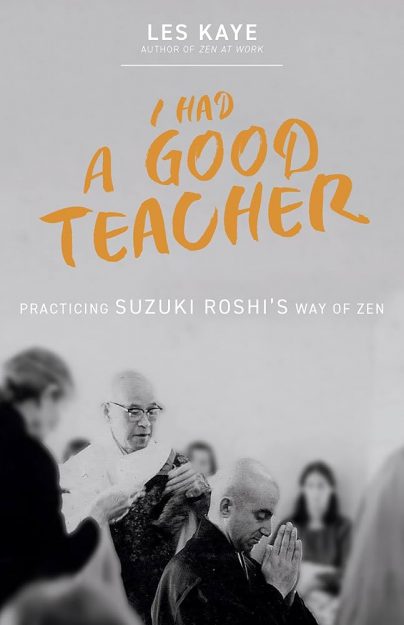
From I Had a Good Teacher: Practicing the Zen Method of Suzuki Roshi © 2025 – Les Kaye. Reprinted with permission from Monkfish Book Publishing Company.



