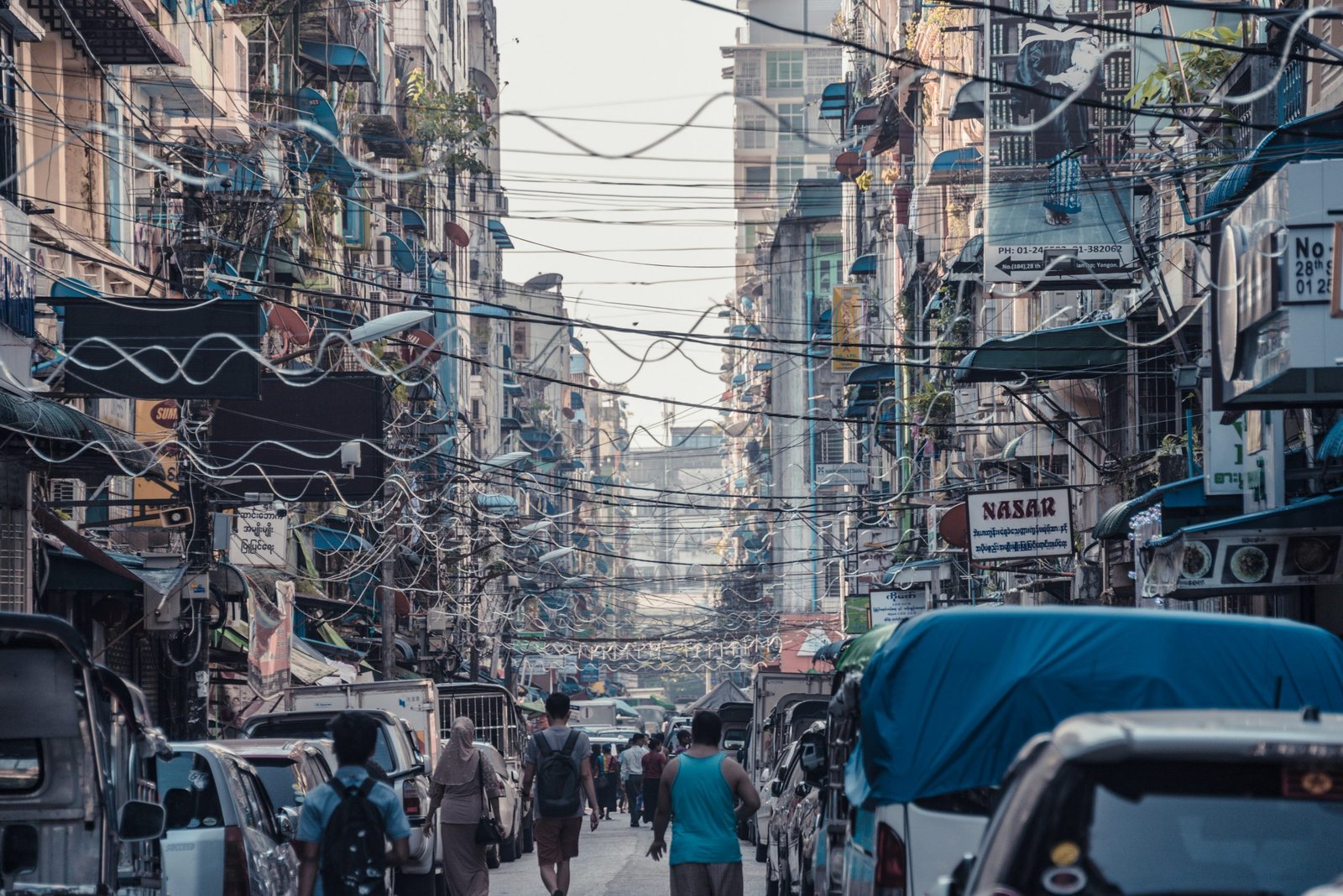

I spent almost exactly one year, the first year of my life, in Yangon. It doesn’t make me feel where I come from. I think one should remember the place one comes from. One must have at least one memory. Although I know from the story of the awakened nativity scene that whatever I remember or forget, I will always be connected to the place where I was born. I know from this story and other birth stories that women return to their childhood homes to give birth to their children. The place one is born from, although it may not be the place one comes from, will always be the place one’s mother comes from.
THE he woke up his motherhowever, the queen did not return to her childhood home. The awakened one gave birth to him in a grove halfway between the palace and his parents’ house, where he was born. He clung to the branch of a salfa, and as he stood, the awakened one emerged from his right side, where a white elephant had touched him in his sleep. The awakened one was therefore born in an in-between place, neither in his mother’s nor in his father’s home, but in a blooming grove, the flowers just blooming.
TThirty-six years after my brother’s birth and death, I asked my mother a question I had never asked her before. What was his name?
Not the name I’ve always known him by, but my parents’ nickname, his home name, which I don’t repeat outside my home. This name doesn’t mean older brother, it’s an endearment that could even be flirtatious if used on a boy who isn’t actually one of his older brothers or cousins. It is not the name that my brother was given only after his death, since he only became a big brother after his death. Not the name my parents used to tell us about him, the older brother who was always younger than us.
I didn’t ask my mother for this name, a name made up for children. I wanted to know what name my parents gave him before he died. The name he was given at birth and which he had to carry through a long and complex life.
I I’m always looking for the beginnings. The first lost, the brother I never met, the country I don’t remember. I am always looking for that moment when I can enter the flow of myself. Not the moment I was born, but long before. The moment of my parents’ union, their wedding held on a mythical bird swimming in an artificial lake, their love that began with a borrowed book, a handwritten letter. Or the moment of my previous death, in my great-grandfather’s body, hiding from the war in the jungle. Or in the body of a stranger who was shot down the street by the first soldier who pulled the first trigger.
Tthere is often a price to pay here intermediatefor which he found the beauty and rested there, as his awakened mother had done, and died seven days after his birth. With his death, he was awakened from the memory of his birth. In Bamar, the word womb includes the word home. The womb is our first home, and as a child I often rubbed my head against my mother’s belly and asked if I could go back. He laughed and said I got too big, I couldn’t fit anymore, and I would laugh too, but it made me sad. There was no way home or back. My own body blocked me. Sometimes I wish I had memories of Yangon to claim. So I could say Yes, I’m from here. My sisters have memories of my grandmother cooking, playing with my grandfather, going to school. My oldest sister remembered walking through the woods to school, having to pass the caged pigs that scared my sister, and once she got lost and spent the evening at the neighbor’s house, unable to find her way home. I have heard their stories so many times as if their memories were mine, but I know they are not. I have no memories.
My mother said my brother’s name. He said it softly and quietly, but without hesitation, as if he had been waiting to say it for years. Only after her name left her lips, left her body, did my mother seem to realize she had said it out loud. The spell is broken. I finally asked the right question.
Little did I know there would be an answer, that my brother would have a different name than what I had always known, that he would have his real name, a name he would have to use when he grew up to be a man. It was as if that was the only name that came to my mother’s mind when I asked, as if she was surprised by the knowledge she still held within herself. The name he gave his first born child. There was sadness in his voice when he said it, but also hope. What does this mean? I asked, although I always resented it when strangers asked the same about my name. I was not a stranger; I had a right to this knowledge.
ISo at the beginning was my parents’ wedding at the Karaweikon, a replica of a royal ark, a palace hall that was taken over by two giant birds on the water. The mythical golden birds with red tails are the guardians of my mother’s nightmares. My mother didn’t want an extravagant wedding; his father booked Karaweik for the reception. Only the best for her daughter, no matter the cost. My mother believed the cost was my brother’s life.
My mother believed that birds were a bad omen. He dreamed that the ark was burning on the lake. A royal ark built long after the king was killed or exiled. Birds are terrifying because they upset the hierarchy of the universe. Low-flying animals close to the sky, reptiles, birds, celestial and animal animals. As a child I imagined thirty-one planes of existence above and below each other, the human realm celestial kingdomsand above the realm of animals, hungry spirits, demons, and hells. Birds flying overhead always made me feel like I was at the bottom of the ocean.
Tthe word home in Bamar is the same as the word house. Aain, a dwelling, a shelter, an abode. An empty word, although the home is full. Aain, like the sound of a gong, or a singing bowl struck on its side. A voice that opens, that begins. Home sounds like a wall, like fullness, a sense of bloat, home, expanding to cover the earth. You can get sick from the thought of home, from the thought of losing it, homesickness can be felt in the body, even though it comes from the language. For Bamars, there is no abstract concept of home. There is a people, a land, a country, all words that evoke patriotic feelings, but home, aain, is very private, very intimate, and every house is home, not just mine. Even the haunted aain is someone’s home, perhaps the spirits, because even the dead need a place to live. In Hungarian, there is no such thing as a haunted house. In this language, all ghosts are homeless, and homeless people are ghosts.
IAt the beginning was a borrowed book with a love letter in it. So as a child, I borrowed book after book from the school library, the public library, and the shelves of generous teachers in search of the first book and the first letter. I have never found the letter, and in the absence of it, I fold myself into the books, bury them. A figure of speech, burying in books, but accurate, because reading was a bit like death for me. When I read it, I left my body for a while and as a ghost haunted the lives of others and watched over them, even inhabited or possessed them. But maybe it was the books that possessed me and filled my body, so that for years afterwards I was caught in this cycle of acquiring and purifying my spirits, reading and writing, reading and writing. It is dying slowly, little by little, not until I am dead, but only until I find it: the moment of my beginning, which is not only mine, not mine at all, which I thought necessarily excluded. A moment that happened long before I was born and long after I died. And while I never found the love letter, I did find bookmarks, scraps of paper, receipts, grocery lists, ticket stubs, and once even a Polaroid of a girl in the backseat of a car, staring straight into the camera.
MBrother y’s name, my mother said, means light.
Not burning, blinding light, not brightness, but soft and pleasant. Do you understand? my mother asked. I can’t explain it.
To me her name sounded like the word enter, inside, win or winn, my mother’s name and my mother’s father’s name. A bright light from within. A window lit up in the twilight, in winter, the snow and the sky are the same white-blue, and the window has a little yellow look, softly lit in the quiet cold. A clean and spacious empty space, I found another translation for my brother’s name. The space between the stars, or between the Earth and the Moon. The light that travels that wide range.
♦
Extract from The Names of Light: A Family History. Copyright © 2021, Thirii Myo Kyaw Myint. Reprinted by permission of The Permissions Company, LLC on behalf of Graywolf Press, Minneapolis, Minnesota, graywolfpress.org.